
AI Agents vs. Chatbots: What SMB Owners Actually Need to Know
By Lukco
Overview
Overview
"AI agent" has become one of those phrases that gets attached to almost anything with a chat interface. That's a problem
"AI agent" has become one of those phrases that gets attached to almost anything with a chat interface. That's a problem, because it makes it hard for a business owner to tell the difference between a genuinely useful tool and a glorified FAQ box — and the two solve completely different problems. Here's the distinction that actually matters, without the hype.
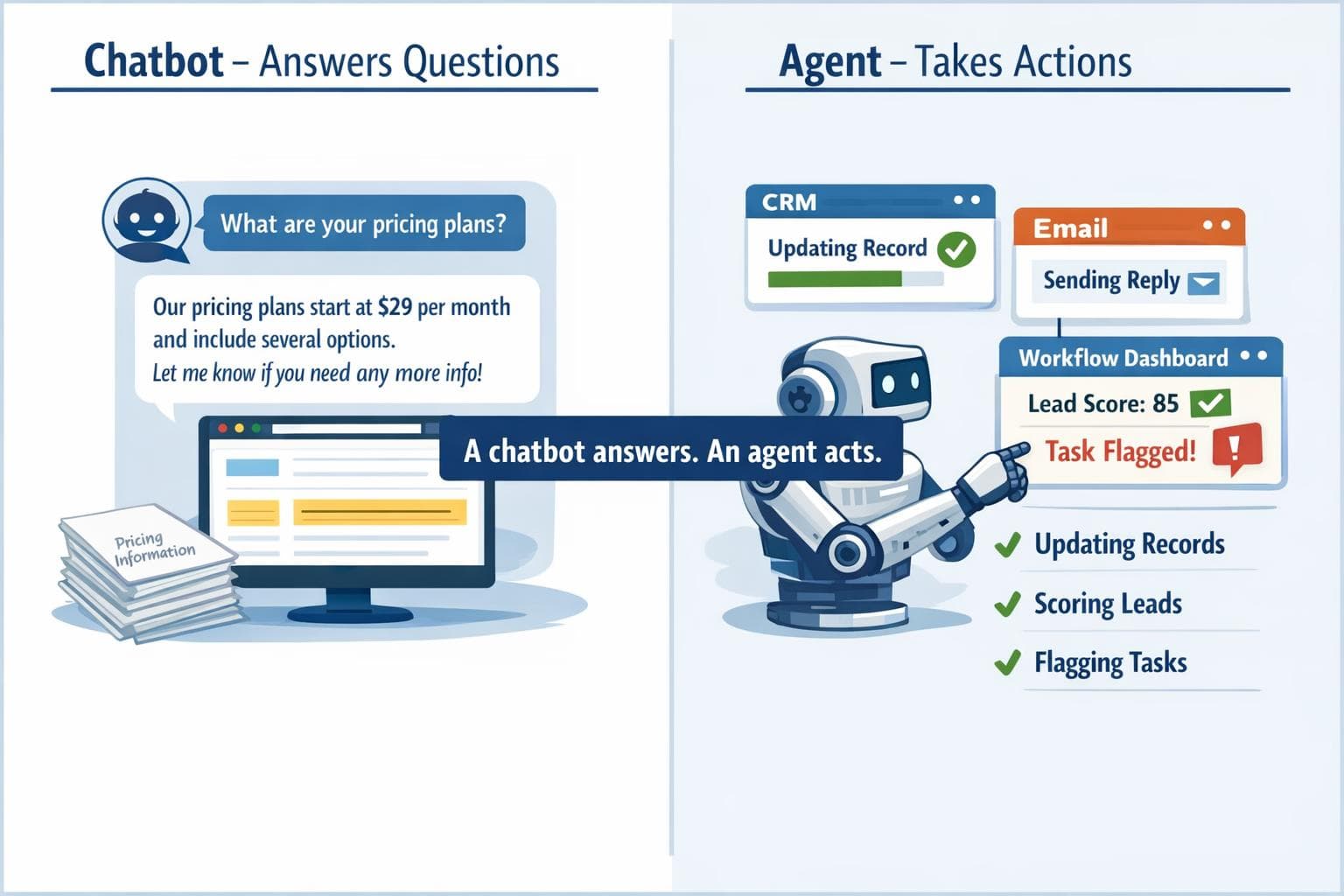
A chatbot answers. An agent acts.
A chatbot, in the traditional sense, is built to hold a conversation and answer questions — usually pulling from a script or a knowledge base. It's useful for deflecting simple support questions or guiding a website visitor to the right page. But at the end of the conversation, nothing has actually happened in your business. No record was updated, no task was completed, no decision was made. An agent is different. It's given a goal and the ability to take real actions to accomplish it — checking a CRM, updating a record, drafting an email, scoring a lead, flagging something for a human to review. The conversation, if there is one, is incidental. The point is the outcome. This is the difference between "answer the customer's question about pricing" and "read this inbound lead, determine if it's qualified, and either book a call or route it to the right follow-up sequence." The second one requires judgment and the ability to touch real systems — which is what makes it valuable, and also what makes it worth getting right.
Why this distinction matters for SMBs specifically
Larger companies can afford to experiment with AI tools that don't quite work yet. SMBs generally can't — every hour spent babysitting a broken automation is an hour not spent on the business. This makes the chatbot-versus-agent distinction a practical, not academic, question. A poorly scoped chatbot is annoying but low-risk. It might frustrate a website visitor, but it's not going to send a wrong invoice or mis-tag a customer record. A poorly scoped agent is a different kind of risk, because it's connected to real systems and taking real actions. This is exactly why agent-based automation should be narrow and well-defined at first — a lead-scoring agent that only scores and flags, for instance, rather than an agent that's been given broad access to send emails, update billing, and modify customer records all at once.
What a well-built agent setup actually looks like
For most SMBs, the highest-value entry point isn't a customer-facing chatbot at all — it's internal agents that handle the repetitive judgment calls currently eating up staff time. A few examples:
- Lead scoring: reading incoming leads and ranking them by fit and intent, so the sales team knows who to call first.
- Outreach drafting: generating a first-pass follow-up email personalized to what's actually in the CRM record, for a human to review and send.
- Pipeline intelligence: flagging deals that have gone quiet, or spotting patterns in why deals are stalling. None of these replace a person. They remove the part of the job that's pure repetition — reading, sorting, drafting — so the person can focus on the part that actually requires judgment: the conversation, the negotiation, the relationship.
The bar to clear before adopting either
Before bringing in a chatbot or an agent, the real question isn't "which AI tool should we use." It's "do we have a clear enough process that a system — human or AI — could follow it correctly." If the answer is no, that's the actual project. The AI comes second. Lukco designs and builds agent-based automation for SMBs — scoped narrowly, wired into your existing CRM, and built to hand off real work without creating new risk. Get in touch if you want to know what a first agent for your business would actually look like.