
Inside a Fixed-Scope Automation Engagement: What It Actually Looks Like
By Lukco
Overview
Overview
"We'll build you a custom automation solution" is one of those phrases that sounds good and tells you almost nothing
"We'll build you a custom automation solution" is one of those phrases that sounds good and tells you almost nothing. It doesn't say what gets delivered, how long it takes, or what happens if the scope quietly grows halfway through. For a business owner deciding whether to invest in automation, that vagueness is a real risk — open-ended projects are exactly how six-week engagements turn into six-month ones. Here's what a fixed-scope engagement actually looks like in practice, step by step.
Step 1: Define the one problem being solved
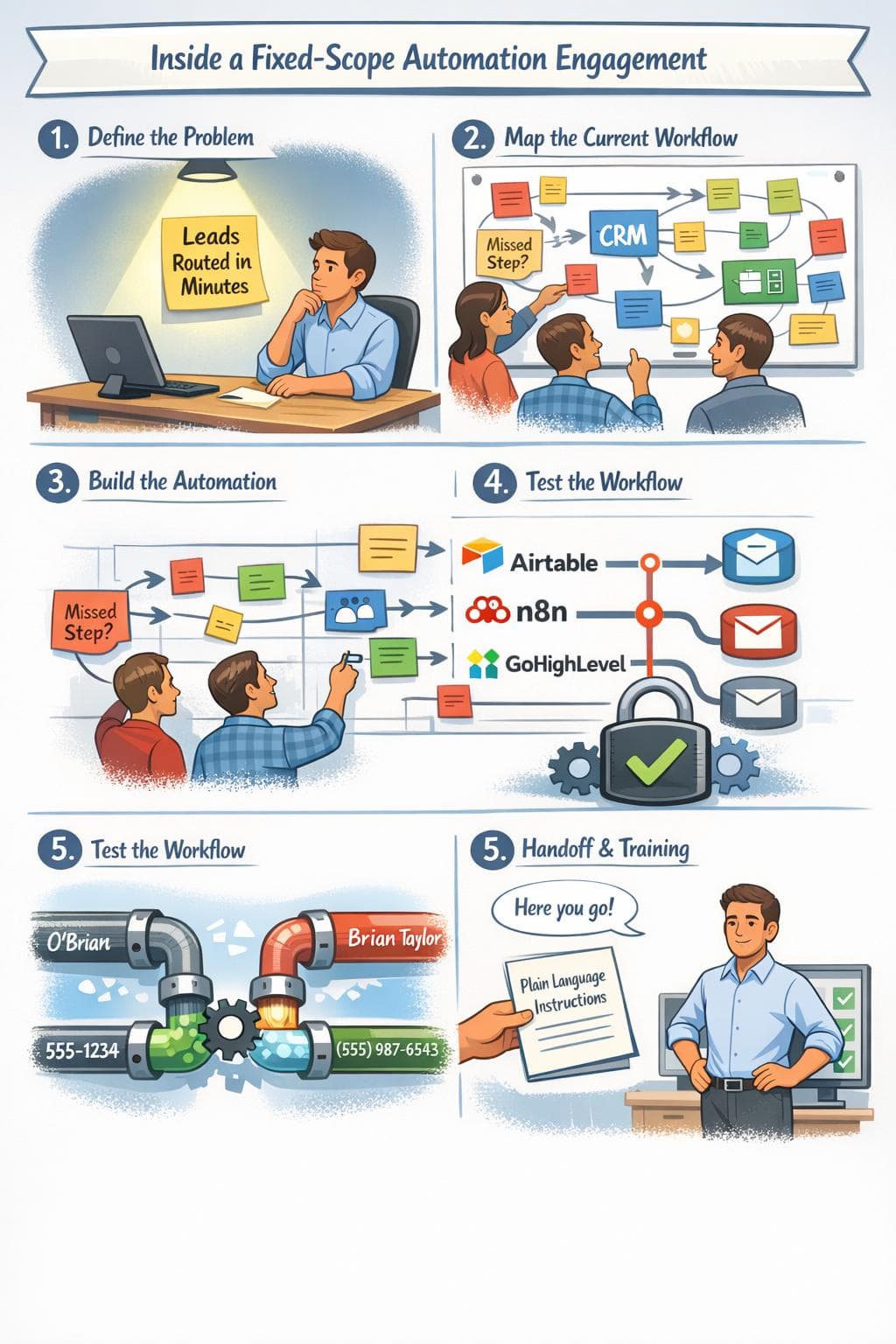
Every engagement starts by narrowing to a single, specific outcome — not "improve our sales process," but something concrete enough to measure: leads get scored and routed automatically within minutes of coming in, or follow-up sequences fire without anyone remembering to trigger them. If a request doesn't have a specific before-and-after, it's not ready to be scoped yet, and that's worth figuring out before any building starts. This step matters more than it sounds like it should. Most automation projects that fail didn't fail during the build — they failed during scoping, because the target was too broad to ever finish.
Step 2: Map what already exists
Before anything new gets built, the current process gets mapped as it actually runs — not the idealized version, the real one, including the manual workarounds and the steps that live only in someone's head. This usually surfaces a few surprises: a step that's done twice by different people, a handoff that regularly gets missed, a piece of information that never makes it into the CRM at all. This mapping also determines what tools are already in play. Automation should work with what a business already uses — the CRM, the spreadsheet, the GoHighLevel account — rather than replacing it. Ripping out and replacing existing systems adds risk and cost without adding much value.
Step 3: Build against a fixed deliverable and timeline
With the problem and the current process both defined, the actual build happens against a locked scope: a specific workflow, wired into specific systems, expected to behave a specific way. Because the scope is fixed upfront, there's no ambiguity later about whether a new request is "part of the project" or a separate ask — which is usually where open-ended engagements start to drift and lose momentum. This is also where the tooling choice matters less than people expect. Airtable, n8n, and GoHighLevel aren't chosen because they're trendy — they're chosen because they're reliable, well-documented, and don't lock a business into a single vendor's ecosystem. The workflow should outlive any particular tool.
Step 4: Test against real data, not a demo scenario
A workflow that works perfectly on a clean test lead often breaks on a real one — a name with an apostrophe, a phone number in a different format, a lead that comes in through an unexpected channel. Before anything goes live, it gets run against actual historical data from the business, specifically to surface these edge cases before they cause a problem with a real customer.
Step 5: Hand off with documentation, not dependency
The last step is deliberately unglamorous: plain-language documentation of what the workflow does, where it lives, and how to make small adjustments without needing to call anyone. A fixed-scope engagement should leave a business more capable, not more dependent. If something needs a bigger change later, that's a new, equally well-scoped project — not an open-ended retainer nobody remembers signing up for.
Why this structure works
Fixed scope isn't a sales tactic — it's what makes automation projects actually ship. A business owner knows exactly what they're getting and when. There's no ambiguity to negotiate mid-project. And because each engagement solves one real problem well, it creates a natural, low-risk next step once the value is proven, instead of a single large bet made on faith. This is how Lukco runs every engagement — one well-defined workflow, built on the tools you already use, delivered on a fixed timeline. Get in touch to talk through what a first project would look like for your business.