
The Agentic Middleware Trap: Why Your AI Stack Needs Fewer Layers, Not More
By Lukco
Overview
Overview
If your AI agent stack has more than three layers of abstraction between your business logic and the LLM API call, you've already lost. Not lost in the sense that your prototype won't work—it probably will, at least in demo mode. Lost in the sense that when you need to diagnose why your agent is hallucinating customer data, or why latency spiked to 8 seconds, or why your costs tripled overnight, you'll be archaeology-ing through framework code you didn't write, reading documentation that hasn't kept pace with the underlying models, and discovering that the "simple" abstraction you adopted six weeks ago has made a simple problem unsolvable. This is the agentic middleware trap, and it's eating production AI teams alive right now. ## The Seduction of Abstraction The pitch is always the same: "Don't reinvent the wheel. Use our framework and you'll have agents talking to each other, managing memory, calling tools, and routing tasks in an afternoon." LangChain, LlamaIndex, CrewAI, AutoGen, Semantic Kernel—pick your poison. They all promise the same thing: complexity collapsed into a few lines of configuration. And they deliver, initially. You can absolutely stand up a multi-agent system faster with a framework than by writing raw API calls. The problem isn't the first 80% of the work. The problem is the last 20%, which in production systems is actually 80% of the effort. Here's what happens: **Phase 1: Velocity** Your team ships a working prototype in days. Agents coordinate. Tools get called. The demo is impressive. Leadership is excited. You feel like you've made the right technical choice. **Phase 2: Friction** You start customizing. You need different prompt templates for different contexts. The framework's built-in memory system doesn't match your data model. You need to inject custom validation before tool calls. Every customization requires fighting the framework's opinions about how things should work. **Phase 3: Opacity** Something breaks in production. An agent loops infinitely. Costs spike. You can't tell which LLM call is failing because it's buried four layers deep in framework abstractions. The logs are generic. The error messages reference internal framework classes. You're debugging someone else's code, not yours. **Phase 4: Abandonment** You start writing escape hatches—custom code that bypasses the framework for critical paths. Then you write more. Eventually, you're maintaining two systems: the framework you adopted for velocity and the custom code you wrote for control. You've paid the complexity tax twice. We see this pattern with almost every client who comes to us after a failed internal AI initiative. The common denominator isn't the use case or the team's skill level. It's the middleware layer they thought would save them time. ## What Actually Breaks The failure modes are predictable: **Latency Compounds** Every abstraction layer adds milliseconds. A framework that "simplifies" agent orchestration might add 200-500ms per agent interaction just in framework overhead—serialization, validation, state management, logging. Multiply that across a multi-turn conversation with three agents and you've added seconds of pure overhead before a single useful LLM call happens. **Prompt Control Evaporates** Frameworks have opinions about prompt structure. They inject system messages, format tool definitions, manage conversation history in specific ways. When you need surgical control over exactly what tokens go to the model—and in production, you always do—you're fighting the framework's template system or abandoning it entirely. **Debugging Becomes Archaeology** When an agent misbehaves, you need to see the exact prompt, the exact response, the exact tool call sequence. Frameworks abstract this away by design. You get high-level logs ("Agent 3 called tool X") but not the raw data. Reproducing issues locally becomes nearly impossible because the framework's state management doesn't match your production environment. **Model Updates Break Everything** OpenAI ships a new model version. Anthropic changes their tool-calling format. Your framework hasn't updated yet, or their update changes behavior in subtle ways. You're now blocked on a third party's release cycle for something that should be a one-line change in your code. **Cost Visibility Dies** You can't optimize what you can't measure. When framework abstractions hide the actual LLM calls, you lose visibility into token usage, caching opportunities, and redundant calls. We've seen clients cut their LLM costs by 60% just by removing framework overhead and implementing basic caching—optimizations that were invisible while the framework was in the way. ## The Case for Boring Directness The alternative isn't to write everything from scratch. It's to embrace boring directness: thin, transparent layers that you control completely. Here's what that looks like in practice: **Direct API Calls** Use the LLM provider's SDK directly. OpenAI's Python library, Anthropic's SDK, Google's Vertex AI client—they're well-documented, stable, and give you complete control. Write a thin wrapper if you need to standardize across providers, but keep it thin. **Explicit Prompt Management** Store prompts as templates you control—Jinja2, f-strings, whatever. Version them. Test them. Don't let a framework decide how your prompts are structured. When you need to change a system message, you should edit a file, not navigate framework documentation. **Simple State Management** Conversation history is a list of messages. Agent state is a dictionary. You don't need a framework's memory abstraction—you need a data structure you understand completely. Store it in Redis, Postgres, or even local memory depending on your scale. Keep it simple. **Transparent Tool Calling** Define tools as functions with clear signatures. Validate inputs explicitly. Log every call. Don't hide tool execution behind framework magic. When a tool call fails, you should see exactly what was called with exactly what arguments. **Observable Everything** Every LLM call should be logged with full prompt, response, tokens used, and latency. Every agent decision should be traceable. Build this observability yourself—it's not hard, and it's the only way to debug production issues and optimize costs. This approach is less impressive in demos. It requires writing more boilerplate upfront. But it scales to production in ways framework-heavy approaches never do. ## When Frameworks Make Sense This isn't a blanket condemnation of all abstraction. There are contexts where frameworks add real value: **Prototyping and Exploration** If you're testing whether an agentic approach even works for your use case, a framework can accelerate learning. Just don't confuse prototype code with production architecture. **Non-Critical Paths** Internal tools, one-off analyses, experimental features—contexts where perfect control and optimization don't matter. Use whatever gets you to done fastest. **Specific, Narrow Problems** Some libraries solve specific problems well: vector search, document parsing, structured output validation. Use those. Just avoid frameworks that try to own your entire agent architecture. The key is knowing the difference between a library (solves one problem, composes with your code) and a framework (imposes architecture, you compose with it). ## What We Build Instead When we build production AI systems for clients, the stack is deliberately boring: - Direct LLM SDK calls with thin internal wrappers for logging and retries - Explicit prompt templates versioned in code - Simple state management with Postgres or Redis - Custom tool definitions as typed Python functions - Comprehensive logging and observability built from day one - Agent orchestration as explicit business logic, not framework configuration This gives us: - **Complete visibility**: Every LLM call is logged with full context - **Surgical control**: Prompt changes are code changes, not framework navigation - **Predictable performance**: No framework overhead, just our code and the LLM API - **Easy debugging**: Production issues reproduce locally because there's no framework state to recreate - **Cost optimization**: We can see and optimize every token spent It's less exciting than announcing we're using the latest agentic framework. But it ships, scales, and doesn't collapse under production load. ## The Real Complexity The dirty secret of production AI systems is that the hard parts aren't the parts frameworks solve. The hard parts are: - Designing prompts that work reliably across edge cases - Handling LLM non-determinism in business-critical workflows - Managing costs at scale - Debugging failure modes that only appear in production - Evolving the system as models and requirements change No framework solves these problems. They require domain expertise, careful engineering, and deep visibility into what's actually happening. Middleware layers make all of these harder by adding distance between you and the behavior you're trying to control. If you're building something that matters—something that has to work reliably, cost-effectively, and maintainably in production—you need that proximity. You need to see the prompts, control the calls, and understand the behavior completely. That means fewer layers, not more. It means boring directness over impressive abstraction. It means writing more boilerplate upfront to avoid archaeology later. The agentic middleware trap is seductive because it promises to make hard things easy. But in production AI, the hard things stay hard. The only question is whether you'll have the visibility and control to solve them when they break. Choose proximity. Choose boring. Choose layers you control completely. Your production system will thank you.
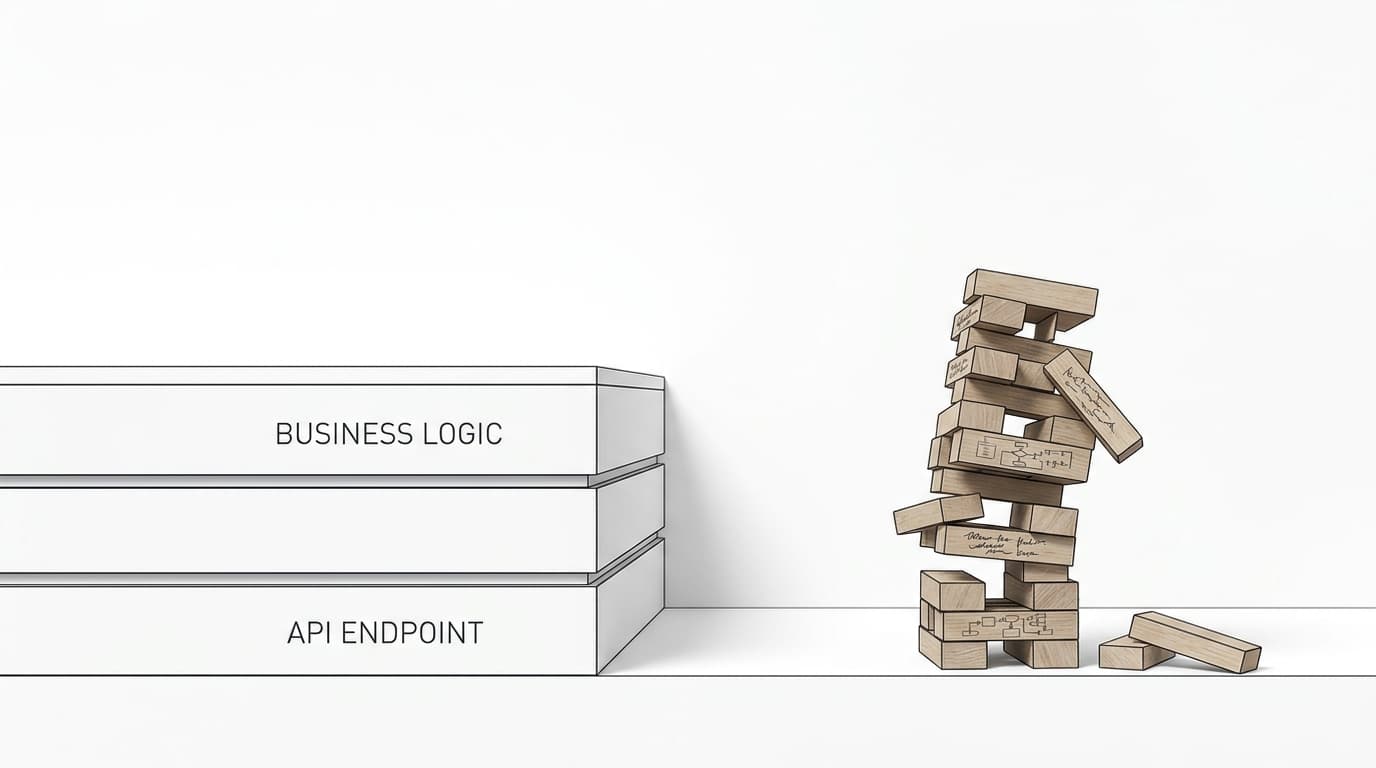
If your AI agent stack has more than three layers of abstraction between your business logic and the LLM API call, you've already lost.
Not lost in the sense that your prototype won't work—it probably will, at least in demo mode. Lost in the sense that when you need to diagnose why your agent is hallucinating customer data, or why latency spiked to 8 seconds, or why your costs tripled overnight, you'll be archaeology-ing through framework code you didn't write, reading documentation that hasn't kept pace with the underlying models, and discovering that the "simple" abstraction you adopted six weeks ago has made a simple problem unsolvable.
This is the agentic middleware trap, and it's eating production AI teams alive right now.
The Seduction of Abstraction
The pitch is always the same: "Don't reinvent the wheel. Use our framework and you'll have agents talking to each other, managing memory, calling tools, and routing tasks in an afternoon." LangChain, LlamaIndex, CrewAI, AutoGen, Semantic Kernel—pick your poison. They all promise the same thing: complexity collapsed into a few lines of configuration.
And they deliver, initially. You can absolutely stand up a multi-agent system faster with a framework than by writing raw API calls. The problem isn't the first 80% of the work. The problem is the last 20%, which in production systems is actually 80% of the effort.
Here's what happens:
Phase 1: Velocity
Your team ships a working prototype in days. Agents coordinate. Tools get called. The demo is impressive. Leadership is excited. You feel like you've made the right technical choice.
Phase 2: Friction
You start customizing. You need different prompt templates for different contexts. The framework's built-in memory system doesn't match your data model. You need to inject custom validation before tool calls. Every customization requires fighting the framework's opinions about how things should work.
Phase 3: Opacity
Something breaks in production. An agent loops infinitely. Costs spike. You can't tell which LLM call is failing because it's buried four layers deep in framework abstractions. The logs are generic. The error messages reference internal framework classes. You're debugging someone else's code, not yours.
Phase 4: Abandonment
You start writing escape hatches—custom code that bypasses the framework for critical paths. Then you write more. Eventually, you're maintaining two systems: the framework you adopted for velocity and the custom code you wrote for control. You've paid the complexity tax twice.
We see this pattern with almost every client who comes to us after a failed internal AI initiative. The common denominator isn't the use case or the team's skill level. It's the middleware layer they thought would save them time.
What Actually Breaks
The failure modes are predictable:
Latency Compounds
Every abstraction layer adds milliseconds. A framework that "simplifies" agent orchestration might add 200-500ms per agent interaction just in framework overhead—serialization, validation, state management, logging. Multiply that across a multi-turn conversation with three agents and you've added seconds of pure overhead before a single useful LLM call happens.
Prompt Control Evaporates
Frameworks have opinions about prompt structure. They inject system messages, format tool definitions, manage conversation history in specific ways. When you need surgical control over exactly what tokens go to the model—and in production, you always do—you're fighting the framework's template system or abandoning it entirely.
Debugging Becomes Archaeology
When an agent misbehaves, you need to see the exact prompt, the exact response, the exact tool call sequence. Frameworks abstract this away by design. You get high-level logs ("Agent 3 called tool X") but not the raw data. Reproducing issues locally becomes nearly impossible because the framework's state management doesn't match your production environment.
Model Updates Break Everything
OpenAI ships a new model version. Anthropic changes their tool-calling format. Your framework hasn't updated yet, or their update changes behavior in subtle ways. You're now blocked on a third party's release cycle for something that should be a one-line change in your code.
Cost Visibility Dies
You can't optimize what you can't measure. When framework abstractions hide the actual LLM calls, you lose visibility into token usage, caching opportunities, and redundant calls. We've seen clients cut their LLM costs by 60% just by removing framework overhead and implementing basic caching—optimizations that were invisible while the framework was in the way.
The Case for Boring Directness
The alternative isn't to write everything from scratch. It's to embrace boring directness: thin, transparent layers that you control completely.
Here's what that looks like in practice:
Direct API Calls
Use the LLM provider's SDK directly. OpenAI's Python library, Anthropic's SDK, Google's Vertex AI client—they're well-documented, stable, and give you complete control. Write a thin wrapper if you need to standardize across providers, but keep it thin.
Explicit Prompt Management
Store prompts as templates you control—Jinja2, f-strings, whatever. Version them. Test them. Don't let a framework decide how your prompts are structured. When you need to change a system message, you should edit a file, not navigate framework documentation.
Simple State Management
Conversation history is a list of messages. Agent state is a dictionary. You don't need a framework's memory abstraction—you need a data structure you understand completely. Store it in Redis, Postgres, or even local memory depending on your scale. Keep it simple.
Transparent Tool Calling
Define tools as functions with clear signatures. Validate inputs explicitly. Log every call. Don't hide tool execution behind framework magic. When a tool call fails, you should see exactly what was called with exactly what arguments.
Observable Everything
Every LLM call should be logged with full prompt, response, tokens used, and latency. Every agent decision should be traceable. Build this observability yourself—it's not hard, and it's the only way to debug production issues and optimize costs.
This approach is less impressive in demos. It requires writing more boilerplate upfront. But it scales to production in ways framework-heavy approaches never do.
When Frameworks Make Sense
This isn't a blanket condemnation of all abstraction. There are contexts where frameworks add real value:
Prototyping and Exploration
If you're testing whether an agentic approach even works for your use case, a framework can accelerate learning. Just don't confuse prototype code with production architecture.
Non-Critical Paths
Internal tools, one-off analyses, experimental features—contexts where perfect control and optimization don't matter. Use whatever gets you to done fastest.
Specific, Narrow Problems
Some libraries solve specific problems well: vector search, document parsing, structured output validation. Use those. Just avoid frameworks that try to own your entire agent architecture.
The key is knowing the difference between a library (solves one problem, composes with your code) and a framework (imposes architecture, you compose with it).
What We Build Instead
When we build production AI systems for clients, the stack is deliberately boring:
- Direct LLM SDK calls with thin internal wrappers for logging and retries
- Explicit prompt templates versioned in code
- Simple state management with Postgres or Redis
- Custom tool definitions as typed Python functions
- Comprehensive logging and observability built from day one
- Agent orchestration as explicit business logic, not framework configuration
This gives us:
- Complete visibility: Every LLM call is logged with full context
- Surgical control: Prompt changes are code changes, not framework navigation
- Predictable performance: No framework overhead, just our code and the LLM API
- Easy debugging: Production issues reproduce locally because there's no framework state to recreate
- Cost optimization: We can see and optimize every token spent
It's less exciting than announcing we're using the latest agentic framework. But it ships, scales, and doesn't collapse under production load.
The Real Complexity
The dirty secret of production AI systems is that the hard parts aren't the parts frameworks solve. The hard parts are:
- Designing prompts that work reliably across edge cases
- Handling LLM non-determinism in business-critical workflows
- Managing costs at scale
- Debugging failure modes that only appear in production
- Evolving the system as models and requirements change
No framework solves these problems. They require domain expertise, careful engineering, and deep visibility into what's actually happening. Middleware layers make all of these harder by adding distance between you and the behavior you're trying to control.
If you're building something that matters—something that has to work reliably, cost-effectively, and maintainably in production—you need that proximity. You need to see the prompts, control the calls, and understand the behavior completely.
That means fewer layers, not more. It means boring directness over impressive abstraction. It means writing more boilerplate upfront to avoid archaeology later.
The agentic middleware trap is seductive because it promises to make hard things easy. But in production AI, the hard things stay hard. The only question is whether you'll have the visibility and control to solve them when they break.
Choose proximity. Choose boring. Choose layers you control completely.
Your production system will thank you.