
The Infrastructure Layer Trap: Why Production-Ready AI Tooling Won't Save Your Agent Strategy
By Lukco
Overview
Overview
# The Infrastructure Layer Trap: Why Production-Ready AI Tooling Won't Save Your Agent Strategy Atlassian shipped MCP support last week, n8n containerised their agent runtime, and Google launched context-aware tooling -- and none of it will fix why your AI agents still can't reliably process an invoice. The past seven days have seen a coordinated buildout of production-grade infrastructure for AI agents. Model Context Protocol integrations, containerised execution environments, context-aware tooling that treats agents as first-class collaborators inside existing work systems. The message is clear: AI-augmented operations are becoming the default state, not an experiment. But here's what nobody is saying in the launch announcements: production-ready infrastructure is only valuable if you have production-ready workflows. And most teams building with AI agents right now don't. They have Notion databases that were never designed for programmatic access. They have approval processes that exist only in Slack threads. They have "the way Sarah does it" encoded nowhere except Sarah's head. Then they bolt on sophisticated agent infrastructure and wonder why reliability stays below 60%. The infrastructure layer is shipping faster than teams can absorb it -- and that's creating a dangerous new pattern. Call it the Infrastructure Layer Trap: the assumption that better tooling will solve problems that are actually workflow design problems in disguise. ## What the Infrastructure Wave Actually Signals When Atlassian, n8n, and Google all ship agent-native features in the same week, they're not just releasing products. They're making a bet about where the market is heading: toward AI agents as persistent, credentialed collaborators inside work systems, not external tools you query. This is the right direction. Agents that can read your Jira board, update your Linear tickets, and post to your Slack channels without human middleware are materially more useful than agents that generate suggestions you manually copy-paste. But the infrastructure layer only creates value when it connects to workflows that are: - **Explicit**: documented in a way agents can parse, not tribal knowledge - **Deterministic**: same input produces same output, not "it depends who's asking" - **Instrumented**: you can see what happened, not just what the agent claimed happened Most teams have none of these. They have workflows that work because humans are excellent at handling ambiguity, reading context, and making judgment calls. Then they try to automate those workflows with agents and discover that "use your best judgment" doesn't compile. The infrastructure layer can't fix this. It can only make it more expensive. ## The Real Workflow Tax Here's what actually happens when you add production-grade agent infrastructure to workflows that aren't ready: **You scale the wrong thing.** Containerised execution environments let you run more agents in parallel. Great -- now you're generating bad outputs faster. MCP lets agents access more context from more systems. Excellent -- now they're making decisions based on data they can access but don't understand. **You create new dependencies.** Every integration point is a new place for things to break. Every context source is a new schema to maintain. Every agent action is a new audit trail to monitor. Infrastructure that promises to reduce operational overhead often just shifts it from "running the agent" to "maintaining the agent's environment." **You hide the workflow problem.** When an agent fails with basic tooling, it's obvious the workflow isn't ready. When it fails with production infrastructure, you assume it's a tuning problem -- better prompts, more context, different model. You spend weeks optimising around a workflow that was never automatable in the first place. This is the trap: infrastructure that's too good, too early. It lets you build things that technically work but operationally fail. ## What Actually Comes First The teams getting real value from AI agents -- the ones running reliable, cost-effective automation in production -- didn't start with infrastructure. They started with workflow archaeology. They picked one workflow. Usually something small: intake form to ticket creation, support request to routing decision, invoice received to data entry. Then they documented it with the assumption that a very literal, very fast intern would be executing it. No "use your judgment." No "you'll know it when you see it." No "check with Sarah if you're not sure." Just: if X, then Y. If not X, then Z. If neither, escalate to human with this specific context. This is harder than it sounds. Most workflows have been optimised for human execution over years. They're full of implicit context, edge cases handled in the moment, and decisions that rely on knowing "how things work around here." Making them agent-ready means making them explicit. Only after that -- after the workflow is documented, tested with humans following it literally, and instrumented so you can see each decision point -- does infrastructure matter. Then MCP is useful because you know exactly what context the agent needs and why. Containerised execution is useful because you know the workflow is deterministic and you want to scale it. Integration tooling is useful because you've proven the workflow works and you want it to touch more systems. Infrastructure becomes an accelerant, not a foundation. ## The Studio-Model Advantage This is where the studio model shows its edge. Traditional consulting firms sell you the infrastructure -- the MCP integration, the custom agent build, the production deployment. They're incentivised to assume your workflows are ready because that's not what they're selling. Studio-model teams work differently. They're embedded in your operations, often part-time, and they're accountable for outcomes not deliverables. Which means they can't afford to build on top of workflows that aren't ready. They start with workflow design: what actually needs to happen, in what order, with what information. They prototype with the simplest possible tooling -- often just a human following a script -- to prove the workflow is sound. Only then do they layer in automation, and only the automation that's justified by volume or complexity. This isn't about being anti-infrastructure. It's about sequencing. Infrastructure is a multiplier. If you multiply a broken workflow by sophisticated tooling, you get an expensive broken workflow. ## What to Do Instead If you're evaluating the new wave of agent infrastructure -- and you should be, because it's genuinely good -- here's the forcing function: **Can you document this workflow well enough that a smart contractor with no context could execute it?** Not an agent. A human. If you can't write instructions clear enough for a person who's never seen your systems before, you're not ready for agent infrastructure. Start there. Pick one workflow. Write it down. Test it with someone who doesn't know your business. Find every place where they have to ask a question or make a judgment call. Make those explicit. Then -- only then -- evaluate whether agent infrastructure adds value. Maybe it does. Maybe you have a workflow that's documented, deterministic, and high-volume enough that containerised execution or MCP integration actually moves the needle. But most teams will discover something else: the workflow wasn't ready. And the act of making it ready -- explicit, documented, instrumented -- often eliminates half the need for sophisticated infrastructure in the first place. ## The Real Infrastructure Problem Here's the irony: the teams that will get the most value from this new infrastructure wave are the ones who need it least. They've already done the workflow design work. They already have explicit, documented, instrumented processes. They're already running agents in production with basic tooling. For them, MCP integrations and containerised execution are genuine upgrades -- more context, better reliability, easier scaling. The infrastructure solves real problems they've already identified. Everyone else is solving the wrong problem. They're building infrastructure for workflows that don't exist yet. And the better the infrastructure gets, the easier it becomes to skip the hard part: figuring out what actually needs to happen, and in what order, and with what information. That's the work. The infrastructure just makes it faster. So before you spin up another MCP server or containerise another agent runtime, ask: do you have a workflow that's ready for this? Or do you have a workflow problem you're trying to solve with infrastructure? Because the infrastructure layer is shipping. It's good. It's getting better. But it won't fix your workflow for you.
The Infrastructure Layer Trap: Why Production-Ready AI Tooling Won't Save Your Agent Strategy
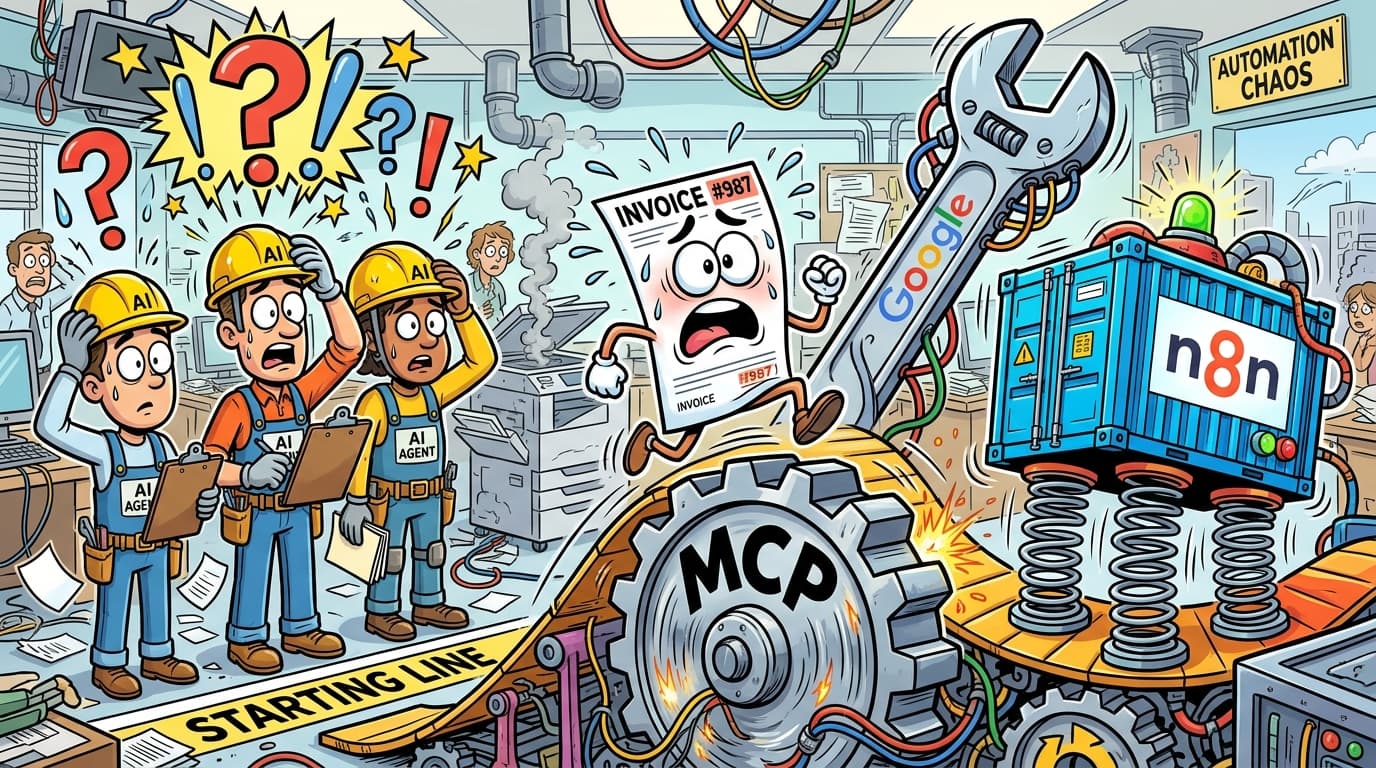
Atlassian shipped MCP support last week, n8n containerised their agent runtime, and Google launched context-aware tooling -- and none of it will fix why your AI agents still can't reliably process an invoice.
The past seven days have seen a coordinated buildout of production-grade infrastructure for AI agents. Model Context Protocol integrations, containerised execution environments, context-aware tooling that treats agents as first-class collaborators inside existing work systems. The message is clear: AI-augmented operations are becoming the default state, not an experiment.
But here's what nobody is saying in the launch announcements: production-ready infrastructure is only valuable if you have production-ready workflows. And most teams building with AI agents right now don't.
They have Notion databases that were never designed for programmatic access. They have approval processes that exist only in Slack threads. They have "the way Sarah does it" encoded nowhere except Sarah's head. Then they bolt on sophisticated agent infrastructure and wonder why reliability stays below 60%.
The infrastructure layer is shipping faster than teams can absorb it -- and that's creating a dangerous new pattern. Call it the Infrastructure Layer Trap: the assumption that better tooling will solve problems that are actually workflow design problems in disguise.
What the Infrastructure Wave Actually Signals
When Atlassian, n8n, and Google all ship agent-native features in the same week, they're not just releasing products. They're making a bet about where the market is heading: toward AI agents as persistent, credentialed collaborators inside work systems, not external tools you query.
This is the right direction. Agents that can read your Jira board, update your Linear tickets, and post to your Slack channels without human middleware are materially more useful than agents that generate suggestions you manually copy-paste.
But the infrastructure layer only creates value when it connects to workflows that are:
- Explicit: documented in a way agents can parse, not tribal knowledge
- Deterministic: same input produces same output, not "it depends who's asking"
- Instrumented: you can see what happened, not just what the agent claimed happened
Most teams have none of these. They have workflows that work because humans are excellent at handling ambiguity, reading context, and making judgment calls. Then they try to automate those workflows with agents and discover that "use your best judgment" doesn't compile.
The infrastructure layer can't fix this. It can only make it more expensive.
The Real Workflow Tax
Here's what actually happens when you add production-grade agent infrastructure to workflows that aren't ready:
You scale the wrong thing. Containerised execution environments let you run more agents in parallel. Great -- now you're generating bad outputs faster. MCP lets agents access more context from more systems. Excellent -- now they're making decisions based on data they can access but don't understand.
You create new dependencies. Every integration point is a new place for things to break. Every context source is a new schema to maintain. Every agent action is a new audit trail to monitor. Infrastructure that promises to reduce operational overhead often just shifts it from "running the agent" to "maintaining the agent's environment."
You hide the workflow problem. When an agent fails with basic tooling, it's obvious the workflow isn't ready. When it fails with production infrastructure, you assume it's a tuning problem -- better prompts, more context, different model. You spend weeks optimising around a workflow that was never automatable in the first place.
This is the trap: infrastructure that's too good, too early. It lets you build things that technically work but operationally fail.
What Actually Comes First
The teams getting real value from AI agents -- the ones running reliable, cost-effective automation in production -- didn't start with infrastructure. They started with workflow archaeology.
They picked one workflow. Usually something small: intake form to ticket creation, support request to routing decision, invoice received to data entry. Then they documented it with the assumption that a very literal, very fast intern would be executing it.
No "use your judgment." No "you'll know it when you see it." No "check with Sarah if you're not sure." Just: if X, then Y. If not X, then Z. If neither, escalate to human with this specific context.
This is harder than it sounds. Most workflows have been optimised for human execution over years. They're full of implicit context, edge cases handled in the moment, and decisions that rely on knowing "how things work around here." Making them agent-ready means making them explicit.
Only after that -- after the workflow is documented, tested with humans following it literally, and instrumented so you can see each decision point -- does infrastructure matter.
Then MCP is useful because you know exactly what context the agent needs and why. Containerised execution is useful because you know the workflow is deterministic and you want to scale it. Integration tooling is useful because you've proven the workflow works and you want it to touch more systems.
Infrastructure becomes an accelerant, not a foundation.
The Studio-Model Advantage
This is where the studio model shows its edge. Traditional consulting firms sell you the infrastructure -- the MCP integration, the custom agent build, the production deployment. They're incentivised to assume your workflows are ready because that's not what they're selling.
Studio-model teams work differently. They're embedded in your operations, often part-time, and they're accountable for outcomes not deliverables. Which means they can't afford to build on top of workflows that aren't ready.
They start with workflow design: what actually needs to happen, in what order, with what information. They prototype with the simplest possible tooling -- often just a human following a script -- to prove the workflow is sound. Only then do they layer in automation, and only the automation that's justified by volume or complexity.
This isn't about being anti-infrastructure. It's about sequencing. Infrastructure is a multiplier. If you multiply a broken workflow by sophisticated tooling, you get an expensive broken workflow.
What to Do Instead
If you're evaluating the new wave of agent infrastructure -- and you should be, because it's genuinely good -- here's the forcing function:
Can you document this workflow well enough that a smart contractor with no context could execute it? Not an agent. A human. If you can't write instructions clear enough for a person who's never seen your systems before, you're not ready for agent infrastructure.
Start there. Pick one workflow. Write it down. Test it with someone who doesn't know your business. Find every place where they have to ask a question or make a judgment call. Make those explicit.
Then -- only then -- evaluate whether agent infrastructure adds value. Maybe it does. Maybe you have a workflow that's documented, deterministic, and high-volume enough that containerised execution or MCP integration actually moves the needle.
But most teams will discover something else: the workflow wasn't ready. And the act of making it ready -- explicit, documented, instrumented -- often eliminates half the need for sophisticated infrastructure in the first place.
The Real Infrastructure Problem
Here's the irony: the teams that will get the most value from this new infrastructure wave are the ones who need it least. They've already done the workflow design work. They already have explicit, documented, instrumented processes. They're already running agents in production with basic tooling.
For them, MCP integrations and containerised execution are genuine upgrades -- more context, better reliability, easier scaling. The infrastructure solves real problems they've already identified.
Everyone else is solving the wrong problem. They're building infrastructure for workflows that don't exist yet. And the better the infrastructure gets, the easier it becomes to skip the hard part: figuring out what actually needs to happen, and in what order, and with what information.
That's the work. The infrastructure just makes it faster.
So before you spin up another MCP server or containerise another agent runtime, ask: do you have a workflow that's ready for this? Or do you have a workflow problem you're trying to solve with infrastructure?
Because the infrastructure layer is shipping. It's good. It's getting better.
But it won't fix your workflow for you.