
The Orchestration Tax: Why Your Voice AI Stack Costs More Than It Should 2
By Luke Ribeiro
Overview
Overview
Your voice AI bill doubled last quarter, but your call quality didn't improve -- because you're optimizing the wrong layer of the stack.
The voice AI infrastructure market is in the middle of a quiet unbundling. Enterprises that spent 2023 locked into monolithic platforms are now ripping them out, replacing single-vendor solutions with modular stacks where speech-to-text, text-to-speech, LLM inference, and telephony come from different providers. On the surface, this looks like the standard cloud story: commoditization drives modularity, modularity drives cost optimization.
But the teams making this migration are discovering something uncomfortable. The cost savings they expected from switching to cheaper STT or shopping LLM providers never materialize. Worse, their operational overhead increases. They're spending more engineer-hours managing provider APIs, debugging latency spikes across service boundaries, and manually routing traffic when one component degrades. The bill goes up, the complexity goes up, and nobody can point to a single line item that explains why.
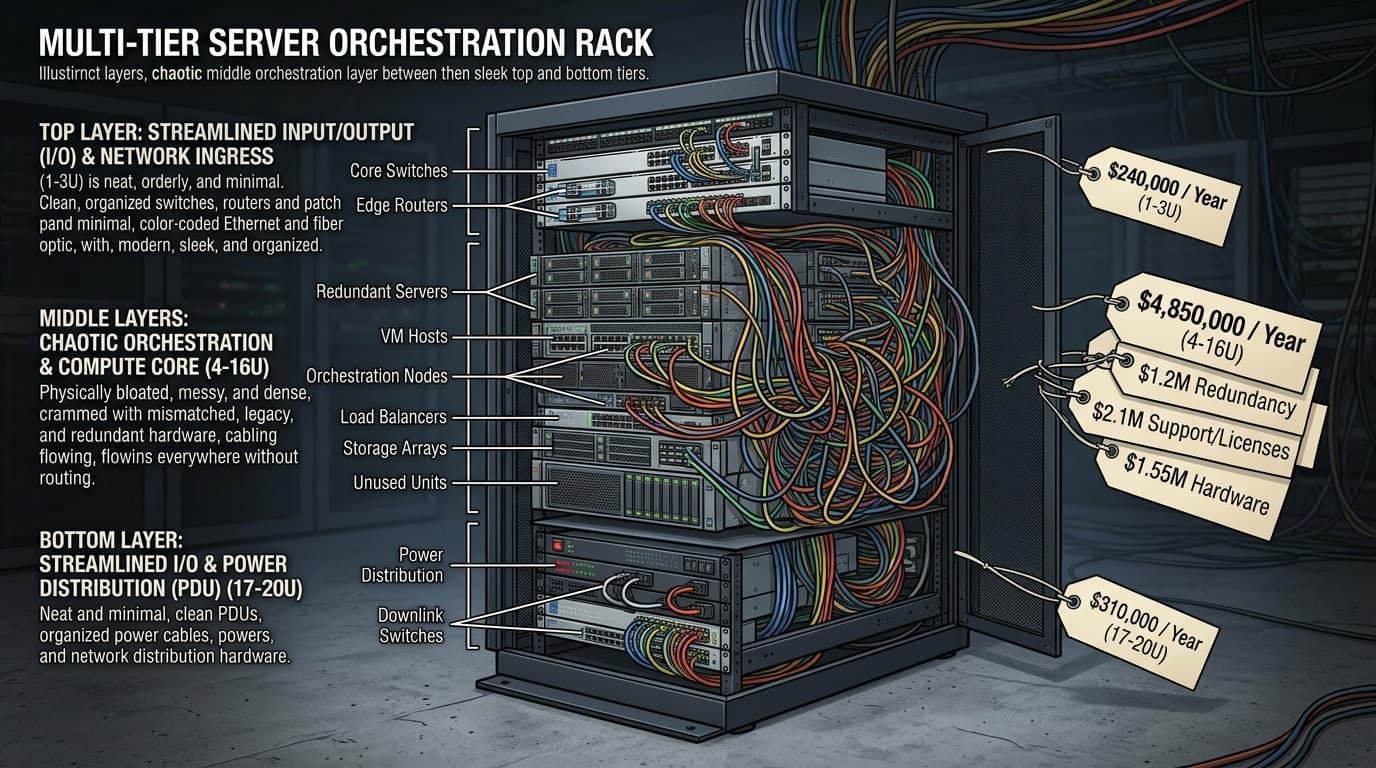
The problem isn't the components. The problem is that most teams treat orchestration -- the layer that routes requests, monitors performance, and switches providers -- as plumbing. It's the thing you build once and forget about, a thin integration layer that just needs to work. But in a modular voice AI stack, orchestration is where all the actual intelligence lives. It's the difference between a system that costs what it should and one that bleeds money on every call.
The Monolith Hid the Orchestration Layer
When you bought a voice AI platform from a single vendor, you weren't just paying for STT and TTS. You were paying for the orchestration layer they built to manage those components at scale -- the logic that routes calls, handles failover, optimizes for latency or cost, and monitors quality in real time. That layer was invisible to you, bundled into the per-minute rate, and it worked well enough that you never thought about it.
The decision to unbundle makes sense on paper. Why pay a markup for Vendor A's STT when Vendor B's is 40% cheaper and just as accurate? Why lock into Vendor A's LLM when you want the flexibility to swap models based on use case? The cost arbitrage is real, and the flexibility is valuable. But when you unbundle, you inherit the orchestration problem. You're now responsible for building the intelligence layer that the monolith provided.
Most teams underestimate this. They treat it as an integration task: write some API wrappers, add a load balancer, maybe set up a retry policy. They get the system working, ship it to production, and then spend the next six months firefighting. Calls drop when one provider has a bad day. Latency spikes because the routing logic doesn't account for regional availability. Costs balloon because the system can't dynamically shift traffic to cheaper providers when quality thresholds are met. The orchestration layer they built works, technically, but it's not intelligent. It's just plumbing.
Orchestration Is Where the Moat Is Now
The insight that separates high-performing voice AI teams from everyone else is this: orchestration is not overhead. It's the layer where competitive advantage lives. The companies that win in a modular stack aren't the ones who picked the best STT provider last quarter. They're the ones who built an orchestration layer smart enough to pick the best STT provider for each call, in real time, based on cost, latency, accuracy requirements, and current provider performance.
This is the same shift that happened in the broader automation market. Early RPA was monolithic -- one platform, one workflow engine, one way to do things. As the market matured, teams moved to composable automation: modular tools, API-first integrations, orchestration layers that stitched everything together. The companies that treated orchestration as strategic infrastructure pulled ahead. The ones that treated it as plumbing stayed stuck.
In voice AI, intelligent orchestration means:
Dynamic provider routing based on real-time performance. If your primary STT provider's latency spikes above 200ms, the system should automatically route new calls to a backup provider without manual intervention. If a cheaper TTS provider meets your quality bar for 80% of use cases, the system should use it by default and only escalate to the premium provider when necessary.
Cost optimization that doesn't sacrifice quality. The goal isn't to always use the cheapest provider. It's to use the cheapest provider that meets your quality threshold for each specific call. That requires real-time monitoring, quality scoring, and the ability to adjust routing rules on the fly.
Failure handling that's invisible to the end user. Provider outages happen. The orchestration layer should detect them, reroute traffic, and log the incident without dropping calls or degrading user experience. This isn't a nice-to-have -- it's table stakes for production systems.
Observability that surfaces the right data. You need to know not just that a call failed, but which component failed, why, and what it cost you. You need to see patterns: is Provider A's STT accuracy dropping for non-native English speakers? Is Provider B's TTS latency spiking during peak hours? The orchestration layer is the only place where you have visibility across the entire stack.
None of this is exotic. It's basic production operations for distributed systems. But most teams building voice AI stacks don't come from a distributed systems background. They come from product or ML backgrounds, and they treat infrastructure as something to get through quickly so they can focus on the "real" work. The result is orchestration layers that technically function but don't actually optimize for anything.
The Orchestration Tax
If you're running a modular voice AI stack and your costs are higher than expected, you're probably paying an orchestration tax. Here's what it looks like:
You're over-provisioning because you can't predict load. Without intelligent routing, you can't confidently shift traffic between providers, so you over-provision on your primary to avoid outages. You're paying for capacity you don't use.
You're using premium providers for calls that don't need them. Your orchestration layer doesn't differentiate between a high-stakes customer support call and a low-stakes internal test call, so everything routes to your most expensive, highest-quality providers.
You're paying for failed calls. When a provider fails, your system retries the same provider instead of failing over to a backup. You're paying twice for the same call.
You're spending engineer time on manual operations. Your team is manually adjusting routing rules, investigating latency issues, and babysitting provider performance because the orchestration layer doesn't surface the right data or automate the obvious fixes.
The orchestration tax isn't a line item on your invoice. It's distributed across over-provisioning, inefficient routing, operational overhead, and lost opportunities to optimize. But it's real, and for most teams, it's larger than the cost savings they got from unbundling in the first place.
Building Orchestration That Doesn't Suck
If you're migrating to a modular voice AI stack, or if you're already there and paying the orchestration tax, here's what matters:
Treat orchestration as a product, not a project. It's not something you build once. It's something you iterate on, monitor, and optimize continuously. The teams that get this right staff it accordingly -- they put senior engineers on it, they instrument it heavily, and they treat it as core infrastructure.
Instrument everything. You need per-call telemetry across every component: latency, cost, quality scores, provider performance. You need to be able to trace a single call through the entire stack and see where time and money were spent. Without this data, you're flying blind.
Automate the obvious decisions. If a provider's latency crosses a threshold, reroute traffic. If a cheaper provider meets your quality bar, use it. If a provider is down, fail over. These shouldn't require human intervention. Build the rules, test them, and let the system run.
Build for failure. Provider outages are not edge cases. They're regular occurrences. Your orchestration layer should assume that any component can fail at any time and route around it gracefully.
Optimize for total cost, not component cost. The cheapest STT provider might have higher error rates, which means more retries, which means higher total cost. The orchestration layer should optimize for the fully-loaded cost of a successful call, not the per-minute rate of individual components.
This isn't a call to build everything in-house. There are emerging tools and platforms that provide intelligent orchestration as a service. But whether you build or buy, the point is the same: orchestration is not plumbing. It's the layer where your modular stack becomes more than the sum of its parts -- or where it falls apart.
The voice AI market is unbundling, and that's good. Modularity creates flexibility, competition drives down costs, and teams get to build stacks optimized for their specific needs. But the teams that win in this new landscape won't be the ones who picked the best components. They'll be the ones who built the intelligence layer that makes those components work together at scale. That layer is orchestration, and it's where your competitive advantage lives now.