
The Voice AI Stack Is Unbundling — And Your Orchestration Layer Is Now Your Moat 2
By Luke Ribeiro
Overview
Overview
If you're still evaluating voice AI platforms as monolithic vendors, you're solving last year's problem. The voice AI stack is unbundling. Not in the abstract, VC-deck sense — in the concrete, production-deployment sense. Enterprises that shipped voice agents six months ago on Vapi or Retell are now ripping out the integrated stack and rebuilding on modular components: a speech-to-text provider here, a text-to-speech engine there, an LLM router in the middle, and a telephony layer that treats the rest as interchangeable. This isn't churn. It's a category reaching the point where the platform becomes a liability. The pattern is familiar if you lived through the RPA era. Monolithic platforms (UiPath, Automation Anywhere) promised end-to-end solutions. They delivered lock-in, vendor-specific scripting languages, and fragile integrations that broke every time Salesforce changed a button label. The teams that won were the ones that stopped buying platforms and started building orchestration layers — thin, intelligent systems that coordinated best-of-breed tools and routed work dynamically. Voice AI is hitting the same inflection point, faster. ## Why the Monolith Breaks Down The integrated voice AI platform made sense in 2023. The technology was new, the components were immature, and the primary risk was "will this work at all?" Vendors bundled STT, TTS, LLM inference, and telephony into a single API because assembly was hard and most teams didn't have the capability to integrate four different services. But two things changed: 1. **The components commoditised.** Deepgram, AssemblyAI, and ElevenLabs are production-grade. OpenAI's Realtime API ships low-latency voice. Twilio and Telnyx offer programmable telephony with five-nines uptime. You no longer need a platform to make the pieces work — you need a reason _not_ to use best-in-class components. 1. **The platform became the constraint.** When your voice agent is embedded in a vendor's stack, you inherit their latency, their model selection, their rate limits, and their roadmap. You can't A/B test Whisper vs. Deepgram. You can't route high-stakes calls to GPT-4 and low-stakes calls to Llama. You can't pre-warm connections or cache responses. The platform optimises for the median use case, and you are not the median. The teams shipping high-volume, high-stakes voice agents — customer support, sales qualification, appointment scheduling — are the first to hit these walls. They need sub-200ms latency. They need cost per call under $0.50. They need to swap providers when one goes down or raises prices. The monolith can't deliver that. ## What Orchestration Actually Means Orchestration is not "stitching together APIs." That's integration. Orchestration is the intelligence layer that decides _which_ API to call, _when_ to call it, and _how_ to handle failure — at runtime, under load, with monitoring and fallback logic baked in. In a decomposed voice stack, orchestration handles: - **Provider routing.** Send this call to Deepgram for STT, that call to AssemblyAI because Deepgram is over quota. Route urgent calls to GPT-4, routine calls to a fine-tuned Llama model. Switch TTS providers mid-conversation if latency spikes. - **State management.** Track conversation context, user intent, and escalation triggers across STT, LLM, and TTS boundaries. Ensure the LLM has the right context window and the TTS engine has the right prosody settings. - **Observability.** Log every component interaction, measure end-to-end latency, detect drift in transcription accuracy or response quality. Surface failures before the customer does. - **Cost control.** Monitor per-call cost in real time. Kill expensive calls early. Shift load to cheaper providers when possible. Enforce budget guardrails without manual intervention. This is not a weekend project. It's infrastructure. And it's where the new moat is. ## Why This Mirrors the RPA-to-Composable Shift The parallel to RPA is not cosmetic. Both categories followed the same arc: 1. **Early days:** Vendors sell end-to-end platforms because assembly is hard and buyers don't know what they need. 2. **Maturity:** Components commoditise, and the platform becomes a constraint. Teams with volume or complexity hit the ceiling. 3. **Unbundling:** Winners build orchestration layers that treat components as interchangeable and compete on the intelligence layer — routing, monitoring, optimisation. In RPA, the orchestration layer looked like Temporal, Prefect, or custom workflow engines. In voice AI, it looks like a routing layer that sits between your application logic and the STT/TTS/LLM/telephony providers. The difference is speed. RPA took a decade to unbundle. Voice AI is doing it in 18 months. ## What This Means for Teams Building Now If you're evaluating voice AI platforms today, the question is not "which vendor has the best features?" It's "how much of this stack do I need to own?" For most teams, the answer is: more than you think, less than you fear. You don't need to build your own STT engine. You don't need to fine-tune your own TTS model. You _do_ need to own the orchestration layer — the logic that routes calls, manages state, enforces cost and latency constraints, and adapts to provider changes without rewriting your application. This is where the leverage is. A well-built orchestration layer lets you: - Ship faster, because you're not waiting for a vendor to support a new model or provider. - Scale cheaper, because you can optimise cost per call in ways the platform never will. - Survive failure, because you have fallback logic and multi-provider redundancy baked in. The teams that treat voice AI as a vendor selection problem will spend 2025 migrating off platforms. The teams that treat it as an orchestration problem will spend 2025 optimising at the margins the platform teams can't reach. ## The Playbook for Decomposing Your Stack If you're already on a monolithic platform and hitting its limits, the migration path is straightforward: 1. **Instrument everything.** Before you rip anything out, measure baseline performance: latency, cost per call, transcription accuracy, user satisfaction. You need to know if the new stack is better. 1. **Decouple one component.** Start with STT or TTS — whichever is the biggest cost or latency bottleneck. Route 10% of traffic to a standalone provider and compare metrics. 1. **Build the routing layer.** This is the hard part. You need logic that decides which provider to use, handles retries and fallbacks, and logs every decision. Don't underestimate this. 1. **Expand incrementally.** Once one component is decoupled and performing better, move to the next. The orchestration layer gets more valuable with each addition. 1. **Optimise at the edges.** Now you can A/B test providers, pre-warm connections, cache responses, and enforce cost guardrails. This is where you pull ahead. This is not a one-sprint project. But it's also not a rewrite. You're adding a layer, not replacing the foundation. ## Where the Market Is Heading The vendors know this is happening. Some are pivoting to become orchestration platforms (Vapi's recent API updates suggest this). Others are doubling down on vertical integration, betting that most teams won't want to manage the complexity. Both will survive, but they'll serve different buyers. The monolith will serve teams that treat voice AI as a feature — a nice-to-have, low-volume, low-stakes. The orchestration layer will serve teams that treat voice AI as infrastructure — high-volume, high-stakes, cost-sensitive. If you're building a product where voice AI is a core competency, you're in the second category. And the window to build the orchestration layer before your competitors do is narrowing. The voice AI stack is unbundling. The question is whether you're building on the components or the intelligence layer. One is a commodity. The other is a moat.
If you're still evaluating voice AI platforms as monolithic vendors, you're solving last year's problem.
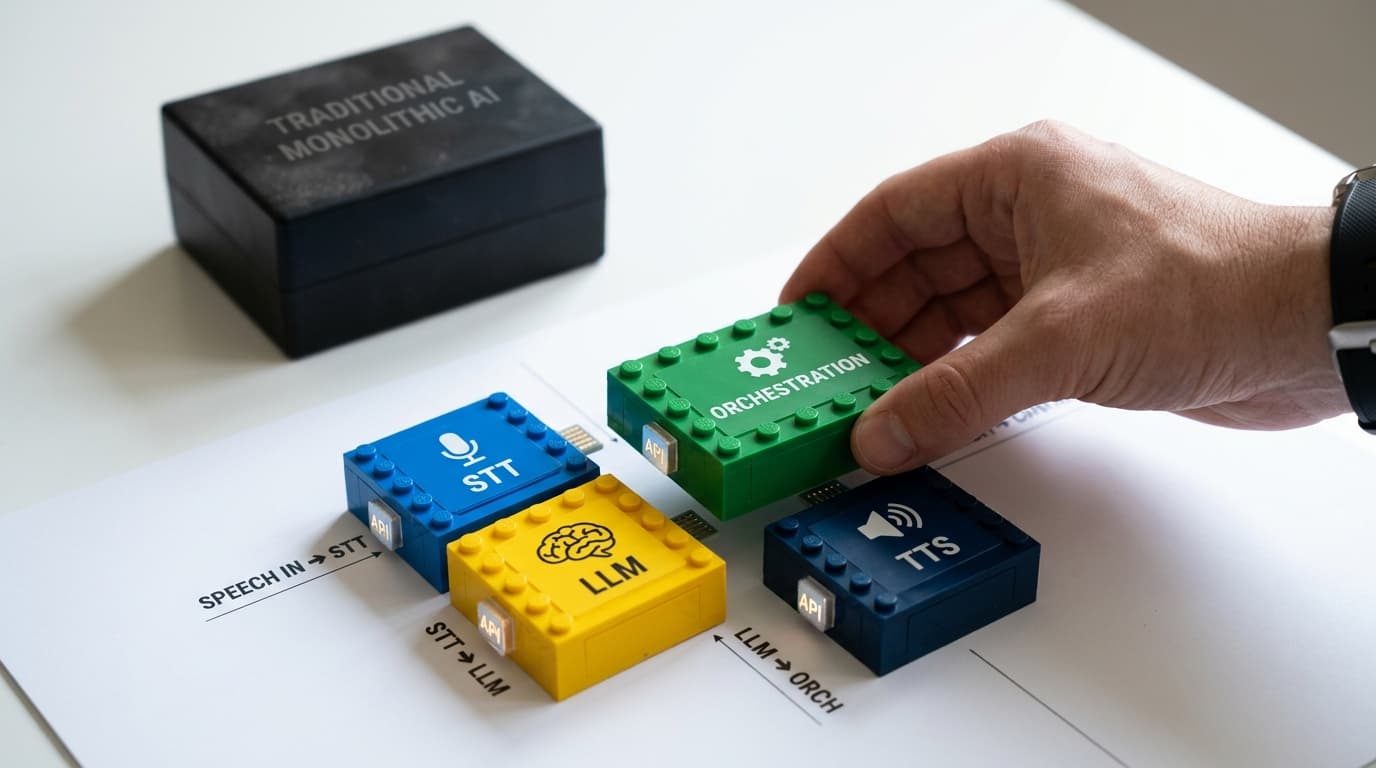
The voice AI stack is unbundling. Not in the abstract, VC-deck sense — in the concrete, production-deployment sense. Enterprises that shipped voice agents six months ago on Vapi or Retell are now ripping out the integrated stack and rebuilding on modular components: a speech-to-text provider here, a text-to-speech engine there, an LLM router in the middle, and a telephony layer that treats the rest as interchangeable.
This isn't churn. It's a category reaching the point where the platform becomes a liability.
The pattern is familiar if you lived through the RPA era. Monolithic platforms (UiPath, Automation Anywhere) promised end-to-end solutions. They delivered lock-in, vendor-specific scripting languages, and fragile integrations that broke every time Salesforce changed a button label. The teams that won were the ones that stopped buying platforms and started building orchestration layers — thin, intelligent systems that coordinated best-of-breed tools and routed work dynamically.
Voice AI is hitting the same inflection point, faster.
Why the Monolith Breaks Down
The integrated voice AI platform made sense in 2023. The technology was new, the components were immature, and the primary risk was "will this work at all?" Vendors bundled STT, TTS, LLM inference, and telephony into a single API because assembly was hard and most teams didn't have the capability to integrate four different services.
But two things changed:
-
The components commoditised. Deepgram, AssemblyAI, and ElevenLabs are production-grade. OpenAI's Realtime API ships low-latency voice. Twilio and Telnyx offer programmable telephony with five-nines uptime. You no longer need a platform to make the pieces work — you need a reason not to use best-in-class components.
-
The platform became the constraint. When your voice agent is embedded in a vendor's stack, you inherit their latency, their model selection, their rate limits, and their roadmap. You can't A/B test Whisper vs. Deepgram. You can't route high-stakes calls to GPT-4 and low-stakes calls to Llama. You can't pre-warm connections or cache responses. The platform optimises for the median use case, and you are not the median.
The teams shipping high-volume, high-stakes voice agents — customer support, sales qualification, appointment scheduling — are the first to hit these walls. They need sub-200ms latency. They need cost per call under $0.50. They need to swap providers when one goes down or raises prices. The monolith can't deliver that.
What Orchestration Actually Means
Orchestration is not "stitching together APIs." That's integration. Orchestration is the intelligence layer that decides which API to call, when to call it, and how to handle failure — at runtime, under load, with monitoring and fallback logic baked in.
In a decomposed voice stack, orchestration handles:
-
Provider routing. Send this call to Deepgram for STT, that call to AssemblyAI because Deepgram is over quota. Route urgent calls to GPT-4, routine calls to a fine-tuned Llama model. Switch TTS providers mid-conversation if latency spikes.
-
State management. Track conversation context, user intent, and escalation triggers across STT, LLM, and TTS boundaries. Ensure the LLM has the right context window and the TTS engine has the right prosody settings.
-
Observability. Log every component interaction, measure end-to-end latency, detect drift in transcription accuracy or response quality. Surface failures before the customer does.
-
Cost control. Monitor per-call cost in real time. Kill expensive calls early. Shift load to cheaper providers when possible. Enforce budget guardrails without manual intervention.
This is not a weekend project. It's infrastructure. And it's where the new moat is.
Why This Mirrors the RPA-to-Composable Shift
The parallel to RPA is not cosmetic. Both categories followed the same arc:
- Early days: Vendors sell end-to-end platforms because assembly is hard and buyers don't know what they need.
- Maturity: Components commoditise, and the platform becomes a constraint. Teams with volume or complexity hit the ceiling.
- Unbundling: Winners build orchestration layers that treat components as interchangeable and compete on the intelligence layer — routing, monitoring, optimisation.
In RPA, the orchestration layer looked like Temporal, Prefect, or custom workflow engines. In voice AI, it looks like a routing layer that sits between your application logic and the STT/TTS/LLM/telephony providers.
The difference is speed. RPA took a decade to unbundle. Voice AI is doing it in 18 months.
What This Means for Teams Building Now
If you're evaluating voice AI platforms today, the question is not "which vendor has the best features?" It's "how much of this stack do I need to own?"
For most teams, the answer is: more than you think, less than you fear.
You don't need to build your own STT engine. You don't need to fine-tune your own TTS model. You do need to own the orchestration layer — the logic that routes calls, manages state, enforces cost and latency constraints, and adapts to provider changes without rewriting your application.
This is where the leverage is. A well-built orchestration layer lets you:
- Ship faster, because you're not waiting for a vendor to support a new model or provider.
- Scale cheaper, because you can optimise cost per call in ways the platform never will.
- Survive failure, because you have fallback logic and multi-provider redundancy baked in.
The teams that treat voice AI as a vendor selection problem will spend 2025 migrating off platforms. The teams that treat it as an orchestration problem will spend 2025 optimising at the margins the platform teams can't reach.
The Playbook for Decomposing Your Stack
If you're already on a monolithic platform and hitting its limits, the migration path is straightforward:
-
Instrument everything. Before you rip anything out, measure baseline performance: latency, cost per call, transcription accuracy, user satisfaction. You need to know if the new stack is better.
-
Decouple one component. Start with STT or TTS — whichever is the biggest cost or latency bottleneck. Route 10% of traffic to a standalone provider and compare metrics.
-
Build the routing layer. This is the hard part. You need logic that decides which provider to use, handles retries and fallbacks, and logs every decision. Don't underestimate this.
-
Expand incrementally. Once one component is decoupled and performing better, move to the next. The orchestration layer gets more valuable with each addition.
-
Optimise at the edges. Now you can A/B test providers, pre-warm connections, cache responses, and enforce cost guardrails. This is where you pull ahead.
This is not a one-sprint project. But it's also not a rewrite. You're adding a layer, not replacing the foundation.
Where the Market Is Heading
The vendors know this is happening. Some are pivoting to become orchestration platforms (Vapi's recent API updates suggest this). Others are doubling down on vertical integration, betting that most teams won't want to manage the complexity.
Both will survive, but they'll serve different buyers. The monolith will serve teams that treat voice AI as a feature — a nice-to-have, low-volume, low-stakes. The orchestration layer will serve teams that treat voice AI as infrastructure — high-volume, high-stakes, cost-sensitive.
If you're building a product where voice AI is a core competency, you're in the second category. And the window to build the orchestration layer before your competitors do is narrowing.
The voice AI stack is unbundling. The question is whether you're building on the components or the intelligence layer. One is a commodity. The other is a moat.