
Why Most SMBs Fail at Automation (And What Actually Works)
By Lukco
Overview
Overview
Most small and mid-sized businesses don't fail at automation because the tools are too complicated. They fail because they automate the wrong thing first.
Most small and mid-sized businesses don't fail at automation because the tools are too complicated. They fail because they automate the wrong thing first.
Here's the pattern we see over and over: a business owner reads about AI, watches a demo, gets excited, and buys a tool. Three months later, that tool is either unused, half-configured, or quietly making things worse — sending the wrong emails to the wrong people, duplicating records, or requiring more manual cleanup than the process it was supposed to replace.
This isn't a tools problem. It's a sequencing problem.
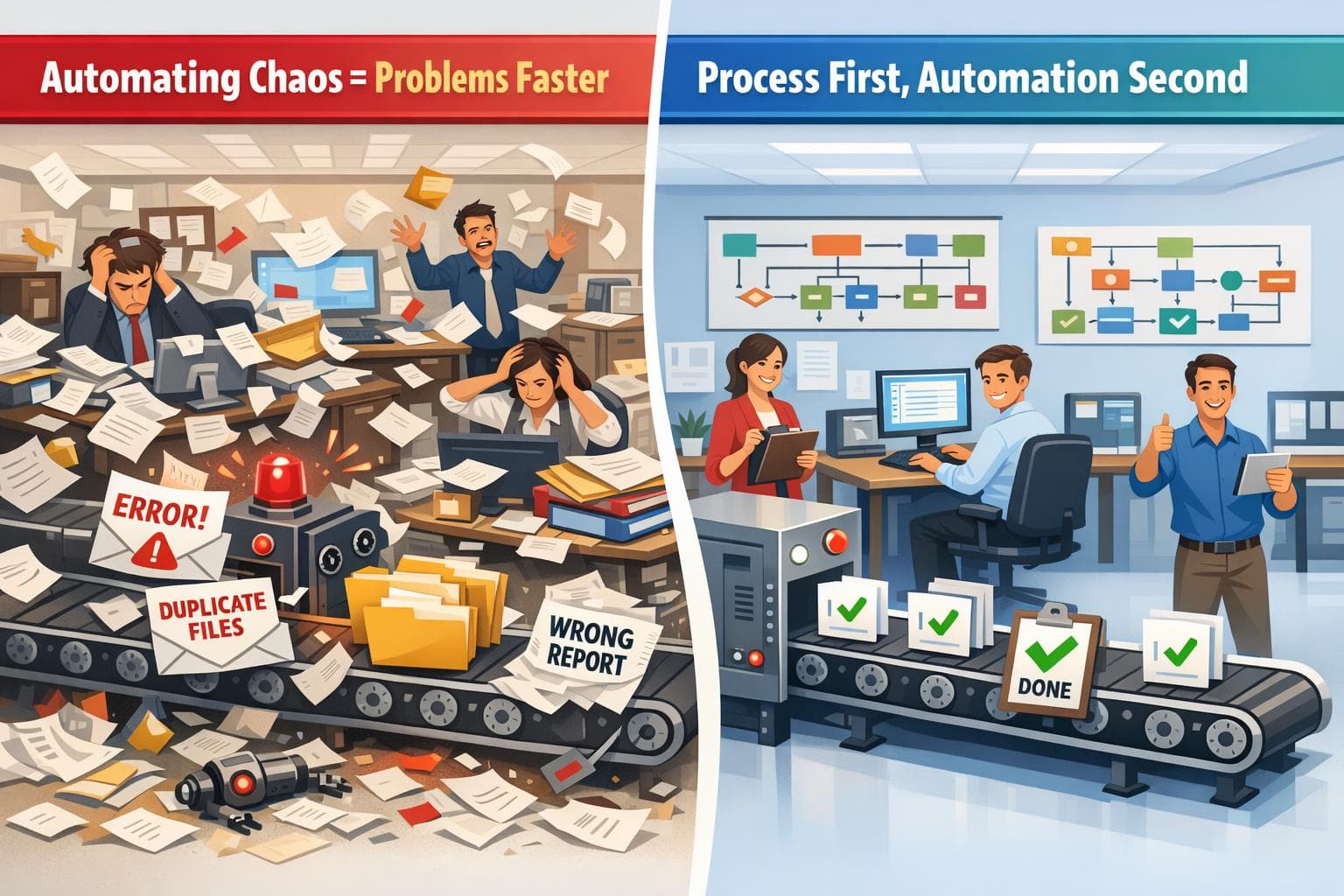
The mistake: automating chaos
If your sales process today is inconsistent — different people following different steps, leads falling through cracks, no clear definition of what happens after someone fills out a form — then automating it just makes the chaos faster. A bad process running on autopilot doesn't become a good process. It becomes a bad process you can't see anymore, because nobody's manually catching the errors it used to catch.
This is why so many CRM rollouts stall. The business bought Salesforce or HubSpot or GoHighLevel expecting the software to create structure. Software doesn't create structure. It enforces structure that already exists — or exposes the fact that it doesn't.
What actually works: process first, automation second
The businesses that get real value from automation do one unglamorous thing before touching any software: they write down what's actually supposed to happen. Not what should happen in theory — what happens right now, step by step, including the annoying parts. When does a lead get a first response? Who owns follow-up after day three? What counts as a qualified opportunity versus a tire-kicker?
Once that's on paper, automation has something to enforce. A lead-scoring workflow can only be useful if there's an actual definition of a good lead. A follow-up sequence can only save time if the follow-up cadence was already decided by a human, not invented by the software.
This is also where the biggest efficiency gains hide. Most SMBs assume automation's value is in doing things faster. The bigger value is usually in doing things consistently — every lead gets the same fast response, every deal gets the same qualification questions, nothing depends on which employee happened to notice it first.
Start narrow, not broad
The second failure mode is scope. Business owners often want to automate "the whole sales process" or "all our customer communication" in one project. That's a recipe for a six-month build that never ships, because every new automation touches five other systems and the requirements keep growing.
The better approach is a single, well-defined workflow with a clear before-and-after: leads get scored automatically instead of manually, or follow-up emails go out within an hour instead of within a week. Ship that. Measure it. Then expand.
This is also why fixed-scope engagements tend to outperform open-ended ones. When the deliverable and timeline are locked in advance, there's no room for the project to quietly expand until it collapses under its own weight.
The real ROI isn't time saved — it's attention freed
The most common way to measure automation is hours saved. That's real, but it's not the biggest win. The bigger win is what a business owner or sales team can pay attention to once they're not manually re-entering data, chasing follow-ups, or triaging inbound leads by hand.
Automation done well doesn't just save time. It changes what the humans in the business get to spend their attention on — which, for most SMBs, is the actual bottleneck to growth.
If you're evaluating automation for your business and want to know what a realistic, well-scoped first project looks like, get in touch — Lukco builds fixed-scope automation systems for SMBs using tools like Airtable, n8n, and GoHighLevel, designed to solve one real bottleneck at a time.