
The Reliability Tax: Why Your AI Agent Needs a Studio Model Around It
By Luke Ribeiro
Overview
Overview
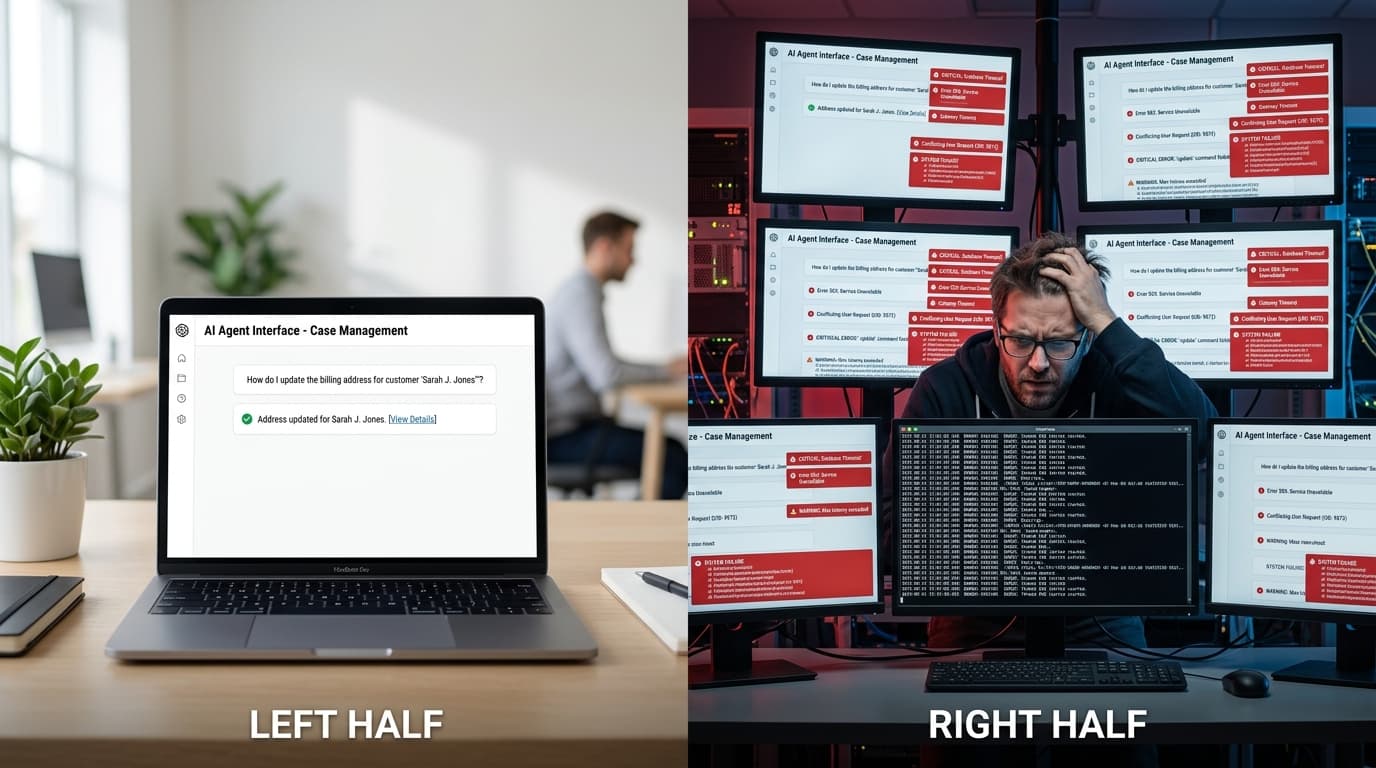
Your agent works in the demo, fails in production, and nobody can tell you why because the logs look fine.
This is the moment most teams building with AI agents hit the reliability wall. The agent performed well in testing. The prompts were tuned. The evals passed. Then it ships, and within days you're seeing edge cases nobody anticipated, outputs that are technically correct but operationally useless, and a growing backlog of "the agent should have caught this" tickets.
The problem isn't the agent. The problem is treating agent deployment like software deployment, when it's actually closer to hiring a contractor with no institutional memory and inconsistent judgment.
We call this the reliability tax: the operational overhead required to make an AI agent dependable enough for production use. Most teams don't budget for it because they're thinking in terms of model performance—better prompts, more sophisticated evals, fine-tuning. But reliability in production isn't a prompt engineering problem. It's a systems design problem, and the solution looks less like MLOps and more like a studio model.
What the Reliability Tax Actually Costs
When we onboard clients who've already built their first agent, the pattern is consistent. They spent three months on the agent itself—prompt iteration, RAG architecture, eval frameworks. They spent two weeks on deployment. Then they spent the next six months on everything else:
Monitoring that actually tells you something. Standard logging doesn't help when the agent's output is plausible but wrong. You need human review loops, spot-checking workflows, and often a dedicated person reading agent outputs daily to catch drift before customers do.
Edge case management. Agents don't fail gracefully—they confidently produce nonsense. Every edge case needs a detection mechanism, a fallback, and often a hand-off protocol to a human. Building these isn't hard; discovering all the edge cases is.
Institutional memory. Agents don't learn from mistakes the way humans do. When an agent mishandles a case, fixing it means updating prompts, adjusting context, or rewriting evals—then validating the fix didn't break something else. This is ongoing work, not a one-time patch.
Operational glue. Agents rarely work in isolation. They need input validation, output formatting, error handling, and integration with existing tools. Someone has to build and maintain this scaffolding, and it's almost never the person who built the agent.
The tax compounds because these aren't one-time costs. Agents drift as models update, as edge cases accumulate, as business requirements shift. Reliability in production means continuous operational work—and most teams don't have the capacity or the structure to do it well.
Why the Studio Model Is the Answer
The studio model solves this by treating the agent as one component in a broader operational system, not the system itself. Instead of asking "how do we make this agent 100% reliable," you ask "how do we build a workflow where the agent's output is consistently usable?"
In practice, this means:
Human-in-the-loop by design, not as a fallback. The agent handles the high-volume, low-stakes work. Humans handle exceptions, edge cases, and judgment calls. The system is designed so these hand-offs are seamless, not emergency patches.
Operational ownership, not just technical ownership. Someone owns the agent's performance in production—not just uptime, but output quality, edge case handling, and continuous improvement. This role looks more like a producer than an engineer.
Iteration based on production data, not evals. Evals tell you if the agent works in theory. Production monitoring tells you if it works in practice. The studio model prioritizes the latter, using real-world failures to drive prompt updates, workflow changes, and capability boundaries.
Modular, replaceable components. Agents are treated as tools, not infrastructure. If a better model ships, you can swap it in. If the agent isn't the right solution for a task, you can replace it with a human or a script. The workflow doesn't depend on the agent being perfect—it depends on the system being resilient.
This isn't about building more sophisticated agents. It's about building systems where agents can be useful without being flawless.
The Mistake: Treating Agents Like Software
The reason most teams underestimate the reliability tax is that they approach agents with a software engineering mindset. Software is deterministic—if it works in staging, it works in production. Agents are probabilistic—if it works in staging, it probably works in production, until it doesn't.
This difference changes everything about how you operate:
Software debugging is about finding the bug. Agent debugging is about finding the pattern of failures and deciding whether to fix the agent, change the workflow, or accept the limitation.
Software scales with infrastructure. Agents scale with operational capacity—the ability to monitor, review, and iterate on outputs.
Software ships when it's feature-complete. Agents ship when the operational system around them is robust enough to handle their failures.
Teams that treat agents like software end up in a cycle: ship the agent, discover reliability issues, add more evals, ship again, discover new issues. The studio model breaks this cycle by designing for unreliability from the start.
What This Looks Like in Practice
One client came to us after building a customer support agent that could handle 60% of inbound tickets. Technically impressive. Operationally unusable, because the 40% it couldn't handle were routed to a support team that had no context on what the agent had already tried.
We didn't improve the agent. We redesigned the workflow:
- Agent attempts a response, flags confidence level
- Low-confidence responses go to a human reviewer before sending
- Failed attempts include a summary of what the agent tried, so the human doesn't start from zero
- Weekly review of failed cases to identify patterns and update prompts
The agent's technical performance stayed the same. The system's reliability went from "occasionally useful" to "dependable enough to scale."
That's the reliability tax. You can pay it upfront by designing for operational resilience, or you can pay it later in firefighting, customer complaints, and abandoned projects. Most teams pay it later because they don't see it coming.
The Real Question
If you're building with agents, the question isn't "how do we make this agent reliable?" It's "what operational system do we need around this agent to make it dependable in production?"
That system includes monitoring, review workflows, hand-off protocols, and continuous iteration—all the unglamorous work that doesn't fit in a demo but determines whether the agent actually ships.
The studio model is how you build that system without hiring a full ops team. It's the infrastructure for making agents useful, not just impressive.
Most teams figure this out six months after their first deployment, after the reliability tax has already compounded. The ones that figure it out earlier treat agents like what they are: powerful tools that need operational scaffolding to be dependable.
You're going to pay the tax either way. The only question is whether you budget for it upfront or let it accumulate as technical and operational debt.