
Why your AI agent needs a studio model, not a product team 2
By Luke Ribeiro
Overview
Overview
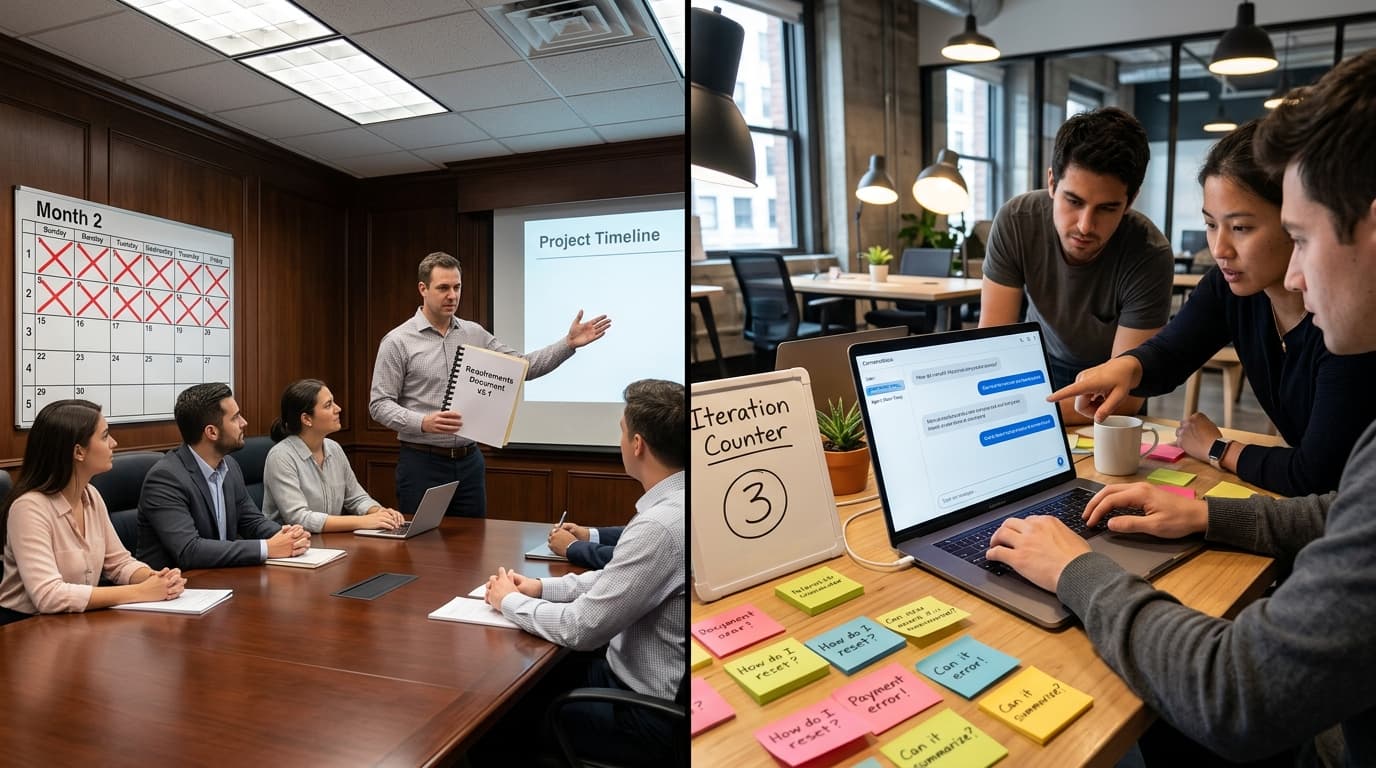
If you're building an AI agent with a product manager writing PRDs, you've already lost six weeks. The standard playbook for building software is to hire a product manager, a designer, and a few engineers, then run two-week sprints toward a roadmap. This works for SaaS products because the problem space is relatively stable: you're building features, you know what 'done' looks like, and you can predict capacity quarters in advance. AI agents break all three of those assumptions. The problem space shifts every time a foundation model updates. 'Done' is a behavior that emerges from iteration, not a spec you can write up front. And capacity is impossible to predict because half the work is figuring out whether the agent should even do the thing you thought it should do. This is why the best teams building agents don't look like product teams. They look like studio teams. ## What a studio model actually means A studio model is how creative agencies, film production companies, and architecture firms staff projects: you have a bench of specialists, you assemble the right combination for a specific engagement, and you rotate people in and out as the needs of the project change. For an AI agent, that might mean: - **Week 1-2:** A systems thinker and a prompt engineer prototype the core agent loop in a notebook, testing whether the behavior is even possible with current models. - **Week 3-4:** A backend engineer and an integration specialist wire the agent into your existing systems, discovering which APIs are actually reliable enough to trust. - **Week 5-6:** A QA-minded generalist and the original systems thinker stress-test edge cases, building evaluation harnesses instead of unit tests. - **Week 7+:** A product-minded operator takes over, running the agent in production and feeding real user interactions back to the systems thinker for the next iteration. Notice what's missing: a PM writing a PRD in week zero. A designer mocking up an agent interface. A sprint planning meeting where you commit to shipping a specific set of capabilities by end of quarter. Those rituals assume you know what you're building. With agents, you're discovering what you're building. ## Why product teams fail at agent development The failure mode is predictable: 1. **The PM writes a spec** based on what they think the agent should do, usually derived from user interviews or competitive analysis. 2. **Engineering builds to the spec**, implementing the agent as a series of deterministic steps with LLM calls plugged in where the spec says "AI magic happens here." 3. **The agent works in demos** because demos follow the happy path, but fails in production because real users don't behave like the personas in the PRD. 4. **The team enters a death loop** of adding guardrails, hardcoding exceptions, and debating whether the agent is "smart enough" or whether the users are "using it wrong." The root cause: product teams are optimized for execution against a known plan. Agent teams need to be optimized for learning. A studio model makes learning the default. You're not asking "did we ship what we said we'd ship?" You're asking "what did we learn, and who do we need next to act on it?" ## The role of the producer In a studio model, you don't have a product manager. You have a producer. The difference: - A **product manager** owns a roadmap, gathers requirements, and ensures the team ships what stakeholders expect. - A **producer** owns the engagement, sequences the work, and ensures the right people are in the room at the right time. For an AI agent, the producer is asking: - "Do we understand the failure modes well enough to bring in an eval specialist, or do we need more production data first?" - "Is this a prompt engineering problem or a system design problem?" - "Should we timebox this experiment at three days, or is this the kind of thing that takes six weeks to know if it's viable?" These are not product questions. They're production questions. The producer doesn't write a spec. They write a creative brief: here's the behavior we're trying to create, here's the constraint we're working within, here's what success looks like this sprint. Then they get out of the way and let the specialists work. ## When to use a studio model vs. a product team This isn't a universal prescription. There are cases where a traditional product team makes sense: - **You're adding AI features to an existing product.** If you're building a "summarize this document" button in your SaaS app, you probably don't need a studio model. You need a backend engineer who can call an LLM API and a PM who can prioritize it against other feature requests. - **You're scaling an agent that already works.** Once you've figured out the core behavior and you're focused on reliability, observability, and cost optimization, a standing team with clear ownership makes sense. - **You have infinite capital and a five-year horizon.** If you're OpenAI or Anthropic building foundational agent infrastructure, you can afford to hire permanent teams and let them explore. Most companies can't. But if you're a Series A startup trying to ship an agent that does something novel, or a growth-stage company experimenting with automation in a new domain, the studio model is faster and cheaper. You don't need to hire a Head of AI. You need to hire a producer who knows how to sequence bets, and a bench of specialists who can rotate in when their expertise is the bottleneck. ## How to staff a studio-model agent team The core roles: 1. **Producer** – Owns the engagement, sequences the work, decides who's in the room. 2. **Systems thinker** – Designs the agent's behavior, writes the initial prompts, owns the mental model of what the agent should do. 3. **Integration specialist** – Connects the agent to your existing systems, APIs, and data sources. 4. **Eval/QA generalist** – Builds harnesses to test agent behavior, identifies edge cases, stress-tests reliability. 5. **Operator** – Runs the agent in production, monitors real usage, feeds insights back to the systems thinker. You don't hire all five at once. You bring them in as needed. Week one might be just the producer and the systems thinker in a room with a notebook. Week four might be all five in a Slack channel debugging why the agent keeps timing out on a specific API call. This is why agencies and consultancies are often better at agent development than in-house teams: they already work this way. They're used to assembling the right people for a specific problem, not maintaining a standing team. ## The trade-off: less ownership, more velocity The downside of a studio model is that no one owns the agent long-term. The systems thinker who designed the initial behavior might not be around when it breaks in production six months later. This is a real trade-off. If you're building something mission-critical that needs to run unsupervised for years, you probably want a standing team with deep ownership. But most companies aren't there yet. They're still figuring out whether the agent should exist at all. For that phase, velocity matters more than ownership. You need to learn fast, pivot cheap, and avoid the sunk cost of a team that's optimized for a roadmap you're going to throw out. The studio model gives you that. You trade long-term ownership for short-term speed. And in a world where the foundation models change every quarter, short-term speed is often the only speed that matters.
If you're building an AI agent with a product manager writing PRDs, you've already lost six weeks.
The standard playbook for building software is to hire a product manager, a designer, and a few engineers, then run two-week sprints toward a roadmap. This works for SaaS products because the problem space is relatively stable: you're building features, you know what 'done' looks like, and you can predict capacity quarters in advance.
AI agents break all three of those assumptions.
The problem space shifts every time a foundation model updates. 'Done' is a behavior that emerges from iteration, not a spec you can write up front. And capacity is impossible to predict because half the work is figuring out whether the agent should even do the thing you thought it should do.
This is why the best teams building agents don't look like product teams. They look like studio teams.
What a studio model actually means
A studio model is how creative agencies, film production companies, and architecture firms staff projects: you have a bench of specialists, you assemble the right combination for a specific engagement, and you rotate people in and out as the needs of the project change.
For an AI agent, that might mean:
- Week 1-2: A systems thinker and a prompt engineer prototype the core agent loop in a notebook, testing whether the behavior is even possible with current models.
- Week 3-4: A backend engineer and an integration specialist wire the agent into your existing systems, discovering which APIs are actually reliable enough to trust.
- Week 5-6: A QA-minded generalist and the original systems thinker stress-test edge cases, building evaluation harnesses instead of unit tests.
- Week 7+: A product-minded operator takes over, running the agent in production and feeding real user interactions back to the systems thinker for the next iteration.
Notice what's missing: a PM writing a PRD in week zero. A designer mocking up an agent interface. A sprint planning meeting where you commit to shipping a specific set of capabilities by end of quarter.
Those rituals assume you know what you're building. With agents, you're discovering what you're building.
Why product teams fail at agent development
The failure mode is predictable:
- The PM writes a spec based on what they think the agent should do, usually derived from user interviews or competitive analysis.
- Engineering builds to the spec, implementing the agent as a series of deterministic steps with LLM calls plugged in where the spec says "AI magic happens here."
- The agent works in demos because demos follow the happy path, but fails in production because real users don't behave like the personas in the PRD.
- The team enters a death loop of adding guardrails, hardcoding exceptions, and debating whether the agent is "smart enough" or whether the users are "using it wrong."
The root cause: product teams are optimized for execution against a known plan. Agent teams need to be optimized for learning.
A studio model makes learning the default. You're not asking "did we ship what we said we'd ship?" You're asking "what did we learn, and who do we need next to act on it?"
The role of the producer
In a studio model, you don't have a product manager. You have a producer.
The difference:
- A product manager owns a roadmap, gathers requirements, and ensures the team ships what stakeholders expect.
- A producer owns the engagement, sequences the work, and ensures the right people are in the room at the right time.
For an AI agent, the producer is asking:
- "Do we understand the failure modes well enough to bring in an eval specialist, or do we need more production data first?"
- "Is this a prompt engineering problem or a system design problem?"
- "Should we timebox this experiment at three days, or is this the kind of thing that takes six weeks to know if it's viable?"
These are not product questions. They're production questions.
The producer doesn't write a spec. They write a creative brief: here's the behavior we're trying to create, here's the constraint we're working within, here's what success looks like this sprint.
Then they get out of the way and let the specialists work.
When to use a studio model vs. a product team
This isn't a universal prescription. There are cases where a traditional product team makes sense:
- You're adding AI features to an existing product. If you're building a "summarize this document" button in your SaaS app, you probably don't need a studio model. You need a backend engineer who can call an LLM API and a PM who can prioritize it against other feature requests.
- You're scaling an agent that already works. Once you've figured out the core behavior and you're focused on reliability, observability, and cost optimization, a standing team with clear ownership makes sense.
- You have infinite capital and a five-year horizon. If you're OpenAI or Anthropic building foundational agent infrastructure, you can afford to hire permanent teams and let them explore. Most companies can't.
But if you're a Series A startup trying to ship an agent that does something novel, or a growth-stage company experimenting with automation in a new domain, the studio model is faster and cheaper.
You don't need to hire a Head of AI. You need to hire a producer who knows how to sequence bets, and a bench of specialists who can rotate in when their expertise is the bottleneck.
How to staff a studio-model agent team
The core roles:
- Producer – Owns the engagement, sequences the work, decides who's in the room.
- Systems thinker – Designs the agent's behavior, writes the initial prompts, owns the mental model of what the agent should do.
- Integration specialist – Connects the agent to your existing systems, APIs, and data sources.
- Eval/QA generalist – Builds harnesses to test agent behavior, identifies edge cases, stress-tests reliability.
- Operator – Runs the agent in production, monitors real usage, feeds insights back to the systems thinker.
You don't hire all five at once. You bring them in as needed.
Week one might be just the producer and the systems thinker in a room with a notebook. Week four might be all five in a Slack channel debugging why the agent keeps timing out on a specific API call.
This is why agencies and consultancies are often better at agent development than in-house teams: they already work this way. They're used to assembling the right people for a specific problem, not maintaining a standing team.
The trade-off: less ownership, more velocity
The downside of a studio model is that no one owns the agent long-term. The systems thinker who designed the initial behavior might not be around when it breaks in production six months later.
This is a real trade-off. If you're building something mission-critical that needs to run unsupervised for years, you probably want a standing team with deep ownership.
But most companies aren't there yet. They're still figuring out whether the agent should exist at all.
For that phase, velocity matters more than ownership. You need to learn fast, pivot cheap, and avoid the sunk cost of a team that's optimized for a roadmap you're going to throw out.
The studio model gives you that. You trade long-term ownership for short-term speed.
And in a world where the foundation models change every quarter, short-term speed is often the only speed that matters.