
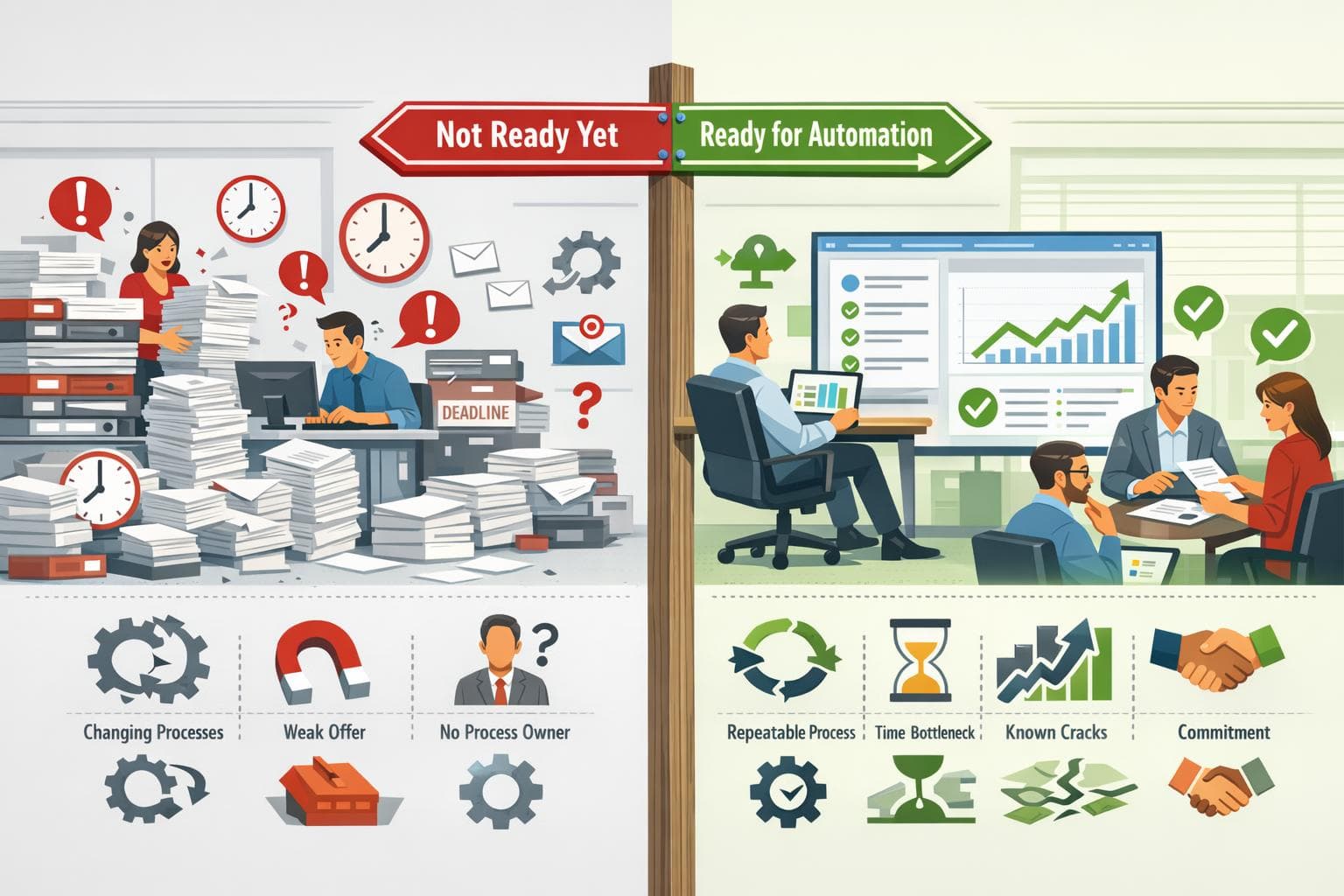
5 Signs Your Business Is Ready for Automation (And 3 Signs You're Not)
By Lukco
Overview
Overview
Automation gets pitched as something every business should be doing right now. That's not quite true. Timing matters
Automation gets pitched as something every business should be doing right now. That's not quite true. Timing matters — automating too early wastes money on a process that hasn't stabilized, and automating too late means leaving real revenue on the table for months or years. Here's how to actually tell where you stand.
You're ready if...
1. You have a repeatable process, even an imperfect one. If the same basic thing happens every time a lead comes in, a customer signs up, or an order gets placed — even if it's not documented anywhere — that repetition is exactly what automation needs to work with. You don't need a perfect process. You need a consistent one. 2. The bottleneck is time, not judgment. If your team is spending hours on tasks that don't actually require a human decision — copying data between systems, sending the same follow-up email, checking whether a form was filled out correctly — that's automatable work. If the bottleneck is genuinely about judgment calls (which customers to prioritize, how to handle a sensitive complaint), automation supports that work but shouldn't try to replace it. 3. You can point to where leads or customers are falling through cracks. If you already know, even vaguely, that follow-up is inconsistent or that some leads never get a real response, you have a specific problem to solve. That specificity is what makes a project ship successfully instead of sprawling. 4. You're growing faster than your current process can handle. A process that worked fine at 20 leads a month starts breaking at 100. If growth is starting to outpace what your team can manually track, that's a strong signal — not that you need more headcount, but that you need the repetitive parts of the process handled automatically so headcount can focus on what actually requires people. 5. You're willing to commit to a defined, narrow first project. Readiness isn't just about the business — it's about the mindset going in. Businesses that succeed with automation start with one well-scoped workflow, measure it, and expand from there. Businesses that struggle tend to want everything solved in one sweeping project.
You're probably not ready yet if...
1. Your process changes every few weeks. If the way you handle leads, orders, or customer requests is still actively evolving — new team members doing it differently, no settled approach — automating it means locking in something that's about to change anyway. Stabilize first. 2. You're looking for automation to fix a sales or service quality problem. Automation can make a good process faster and more consistent. It can't turn a weak sales pitch into a strong one, or a poor customer experience into a good one. If the underlying offer or service has real gaps, that's the priority. 3. You don't have anyone who can own it internally. Automation isn't "set and forget." Someone on your team needs to understand what the workflow does, notice if something looks wrong, and be the point of contact for adjustments. If there's genuinely no one who can play that role, even part-time, an automation project is more likely to quietly break and go unnoticed.
The honest version of readiness
Most SMBs are somewhere in between — parts of the business are ready, parts aren't. The useful move isn't to answer "are we ready" as a yes-or-no for the whole company. It's to find the one process that clears all five signs above, and start there. If you're not sure whether a specific part of your business is ready, that's a five-minute conversation, not a big commitment. Get in touch and we'll help you figure out where the real starting point is.