
The Agentic Studio Model: Why AI-Native Teams Ship Faster Than Traditional Agencies
By Luke Ribeiro
Overview
Overview
Most agencies still charge you for the time it takes a junior to do what an agent could do in four minutes. That's not a pricing problem. It's a structural one. Traditional agencies are optimized for billable hours, headcount growth, and utilization rates. The more people on a project, the more revenue. The longer something takes, the better the margin story at year-end. AI-native studios operate under completely different assumptions. At Lukco, we treat agents as first-class team members, not productivity boosters for humans. We build reusable automation infrastructure, not one-off scripts. And we scale output without scaling payroll, which changes everything about how we price, staff, and deliver work. This isn't about using ChatGPT to write faster emails. It's about fundamentally different operating mechanics. ## The Traditional Agency Model Isn't Built for This Traditional agencies — whether creative, dev shops, or consultancies — share a common economic structure: - **Revenue scales with headcount.** More clients means more hires. Growth means bigger teams. - **Pricing is time-based.** Hourly rates, retainers calculated on FTE allocation, or fixed bids that are secretly just hourly estimates with a buffer. - **Utilization is the key metric.** If your team isn't 80%+ billable, you have a problem. Bench time is waste. - **Specialization creates silos.** Strategists don't code. Developers don't write. Designers don't do data work. Collaboration happens in handoffs. This model made sense when human labor was the only input. But it creates the wrong incentives for AI-native work: - **It penalizes speed.** If an agent can do in four minutes what used to take four hours, you've just destroyed 95% of the revenue opportunity under hourly pricing. - **It discourages reusability.** Building a reusable automation means you can't bill the next client for the same work. Better to rebuild from scratch each time. - **It rewards complexity.** The more meetings, the more revisions, the more layers of review — the more you can bill. Efficiency is a margin problem. Most agencies trying to 'add AI' bolt agent tools onto this structure. They use AI to make their existing people faster, which helps margin but doesn't change the business model. The result: incremental improvement, not transformation. ## What the Studio Model Changes An AI-native studio starts from different first principles: **1. Agents are team members, not tools.** At Lukco, agents aren't assistants that help humans work faster. They're first-class contributors with specific responsibilities: - A research agent owns competitive intel gathering, not a junior analyst using ChatGPT. - A QA agent owns test case generation and execution, not a developer with Copilot. - A content agent drafts long-form pieces from structured briefs, not a writer with an AI sidebar. This distinction matters. When an agent is a tool, a human still owns the task and the agent just speeds up part of it. When an agent is a team member, the human owns the _outcome_ and the agent owns the _execution_. The workflow, the handoffs, the quality bar — all of it gets redesigned around this. **2. Infrastructure is reusable, not bespoke.** Traditional agencies rebuild the same solutions for every client because billing incentivizes it. AI-native studios build infrastructure once and apply it across clients. Example: We built a modular content pipeline that ingests source material (intel reports, knowledge bases, client briefs), routes it to the right agent based on content type, generates drafts, and queues them for human review. The first client paid for the build. Every subsequent client benefits from a mature, debugged system and pays for _application_, not _development_. This changes pricing. Instead of estimating hours, we price based on outcomes and volume. A client isn't paying for the time it takes to generate 20 blog post ideas — they're paying for 20 high-quality ideas that fit their strategy, regardless of whether that takes an agent four minutes or four hours. **3. Humans focus on judgment, not execution.** In a traditional agency, humans do everything: research, drafting, formatting, QA, revisions. In a studio model, humans do the work that requires judgment: - Setting strategy and defining success criteria. - Reviewing agent output and deciding what ships. - Handling edge cases and exceptions the agent can't resolve. - Iterating on the system itself — improving prompts, refining workflows, training new agent capabilities. This isn't about 'letting AI do the boring stuff so humans can be creative.' It's about recognizing that humans are expensive, slow, and inconsistent at execution, and excellent at pattern recognition, taste, and strategic decision-making. The studio model optimizes for that. **4. Scaling doesn't require hiring.** When a traditional agency wins a big client, the first question is: _Do we have the capacity?_ If not, you hire. If you do, you hope the work doesn't dry up in six months and leave the new hires on the bench. In a studio model, scaling output is a configuration problem, not a hiring problem. Need to double content production? Add capacity to the agent pipeline. Need to expand into a new format? Train a new agent or extend an existing one. Need to onboard a second client in the same vertical? Apply the same infrastructure with client-specific context. This doesn't mean studios never hire. But hiring happens when you need new _capabilities_ (a new domain, a new service line, a new type of judgment), not when you need more _capacity_. ## What This Looks Like in Practice A client comes to us needing a high-volume content engine: 15-20 pieces per week across blog posts, case studies, and LinkedIn content. All of it needs to be on-brand, strategically sound, and grounded in their product narrative. Traditional agency approach: - Hire a content strategist (full-time or fractional). - Hire 2-3 writers to handle volume. - Hire an editor to review everything. - Build a project management process to coordinate handoffs. - Price it as a retainer based on FTE allocation: $30-50K/month, depending on seniority. Studio approach: - One senior strategist owns the content roadmap and defines success criteria for each piece. - A content agent generates drafts from structured briefs (title, angle, key points, target audience). - The strategist reviews agent output, edits for voice and precision, and approves what ships. - A QA agent checks for brand consistency, broken logic, and SEO basics before human review. - Price it based on output and quality bar: $12-18K/month for the same volume, with faster iteration cycles and no ramp time for new hires. The difference isn't just cost. It's speed, consistency, and the ability to scale up or down without hiring/firing. ## Why This Model Isn't for Everyone The studio model has real trade-offs: - **It requires infrastructure investment up front.** You can't bill a client for the time it takes to build your agent pipeline. You build it, prove it works, then apply it. - **It requires humans who can work with agents.** Not everyone wants to review agent output instead of doing the work themselves. Some people find it less satisfying. Others find it liberating. - **It requires different client expectations.** Clients used to 'throwing bodies at the problem' need to trust that a small team with good infrastructure can outperform a large team with manual processes. But for founders, operators, and technical decision-makers building with AI — the people who already understand that agents aren't a nice-to-have, they're a different way of working — the studio model is the only one that makes sense. Because the alternative is paying agency rates for work that an agent should own, waiting weeks for deliverables that could be drafted in minutes, and scaling costs linearly with output when the economics of AI are fundamentally non-linear. The studio model isn't the future of agencies. It's a different species entirely.
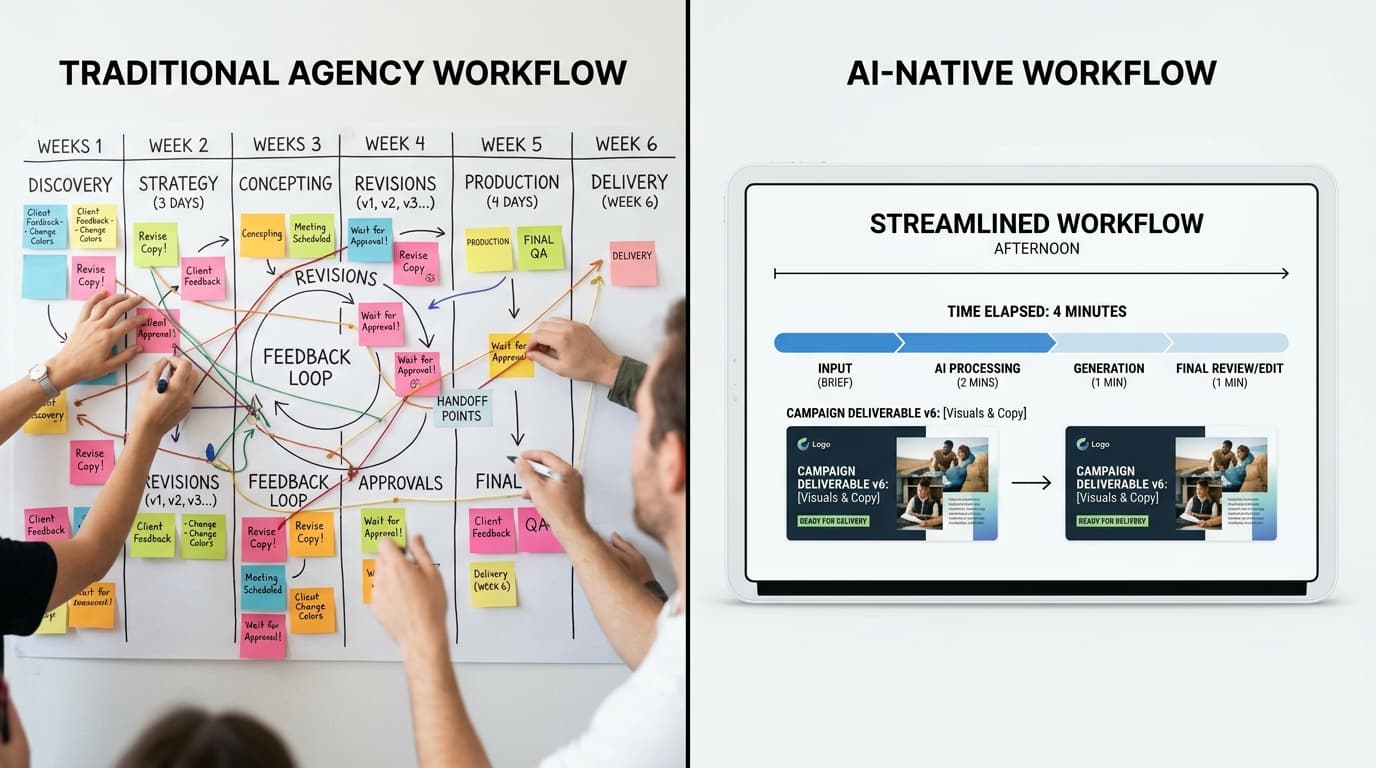
Most agencies still charge you for the time it takes a junior to do what an agent could do in four minutes.
That's not a pricing problem. It's a structural one. Traditional agencies are optimized for billable hours, headcount growth, and utilization rates. The more people on a project, the more revenue. The longer something takes, the better the margin story at year-end.
AI-native studios operate under completely different assumptions. At Lukco, we treat agents as first-class team members, not productivity boosters for humans. We build reusable automation infrastructure, not one-off scripts. And we scale output without scaling payroll, which changes everything about how we price, staff, and deliver work.
This isn't about using ChatGPT to write faster emails. It's about fundamentally different operating mechanics.
The Traditional Agency Model Isn't Built for This
Traditional agencies — whether creative, dev shops, or consultancies — share a common economic structure:
- Revenue scales with headcount. More clients means more hires. Growth means bigger teams.
- Pricing is time-based. Hourly rates, retainers calculated on FTE allocation, or fixed bids that are secretly just hourly estimates with a buffer.
- Utilization is the key metric. If your team isn't 80%+ billable, you have a problem. Bench time is waste.
- Specialization creates silos. Strategists don't code. Developers don't write. Designers don't do data work. Collaboration happens in handoffs.
This model made sense when human labor was the only input. But it creates the wrong incentives for AI-native work:
- It penalizes speed. If an agent can do in four minutes what used to take four hours, you've just destroyed 95% of the revenue opportunity under hourly pricing.
- It discourages reusability. Building a reusable automation means you can't bill the next client for the same work. Better to rebuild from scratch each time.
- It rewards complexity. The more meetings, the more revisions, the more layers of review — the more you can bill. Efficiency is a margin problem.
Most agencies trying to 'add AI' bolt agent tools onto this structure. They use AI to make their existing people faster, which helps margin but doesn't change the business model. The result: incremental improvement, not transformation.
What the Studio Model Changes
An AI-native studio starts from different first principles:
1. Agents are team members, not tools.
At Lukco, agents aren't assistants that help humans work faster. They're first-class contributors with specific responsibilities:
- A research agent owns competitive intel gathering, not a junior analyst using ChatGPT.
- A QA agent owns test case generation and execution, not a developer with Copilot.
- A content agent drafts long-form pieces from structured briefs, not a writer with an AI sidebar.
This distinction matters. When an agent is a tool, a human still owns the task and the agent just speeds up part of it. When an agent is a team member, the human owns the outcome and the agent owns the execution. The workflow, the handoffs, the quality bar — all of it gets redesigned around this.
2. Infrastructure is reusable, not bespoke.
Traditional agencies rebuild the same solutions for every client because billing incentivizes it. AI-native studios build infrastructure once and apply it across clients.
Example: We built a modular content pipeline that ingests source material (intel reports, knowledge bases, client briefs), routes it to the right agent based on content type, generates drafts, and queues them for human review. The first client paid for the build. Every subsequent client benefits from a mature, debugged system and pays for application, not development.
This changes pricing. Instead of estimating hours, we price based on outcomes and volume. A client isn't paying for the time it takes to generate 20 blog post ideas — they're paying for 20 high-quality ideas that fit their strategy, regardless of whether that takes an agent four minutes or four hours.
3. Humans focus on judgment, not execution.
In a traditional agency, humans do everything: research, drafting, formatting, QA, revisions. In a studio model, humans do the work that requires judgment:
- Setting strategy and defining success criteria.
- Reviewing agent output and deciding what ships.
- Handling edge cases and exceptions the agent can't resolve.
- Iterating on the system itself — improving prompts, refining workflows, training new agent capabilities.
This isn't about 'letting AI do the boring stuff so humans can be creative.' It's about recognizing that humans are expensive, slow, and inconsistent at execution, and excellent at pattern recognition, taste, and strategic decision-making. The studio model optimizes for that.
4. Scaling doesn't require hiring.
When a traditional agency wins a big client, the first question is: Do we have the capacity? If not, you hire. If you do, you hope the work doesn't dry up in six months and leave the new hires on the bench.
In a studio model, scaling output is a configuration problem, not a hiring problem. Need to double content production? Add capacity to the agent pipeline. Need to expand into a new format? Train a new agent or extend an existing one. Need to onboard a second client in the same vertical? Apply the same infrastructure with client-specific context.
This doesn't mean studios never hire. But hiring happens when you need new capabilities (a new domain, a new service line, a new type of judgment), not when you need more capacity.
What This Looks Like in Practice
A client comes to us needing a high-volume content engine: 15-20 pieces per week across blog posts, case studies, and LinkedIn content. All of it needs to be on-brand, strategically sound, and grounded in their product narrative.
Traditional agency approach:
- Hire a content strategist (full-time or fractional).
- Hire 2-3 writers to handle volume.
- Hire an editor to review everything.
- Build a project management process to coordinate handoffs.
- Price it as a retainer based on FTE allocation: $30-50K/month, depending on seniority.
Studio approach:
- One senior strategist owns the content roadmap and defines success criteria for each piece.
- A content agent generates drafts from structured briefs (title, angle, key points, target audience).
- The strategist reviews agent output, edits for voice and precision, and approves what ships.
- A QA agent checks for brand consistency, broken logic, and SEO basics before human review.
- Price it based on output and quality bar: $12-18K/month for the same volume, with faster iteration cycles and no ramp time for new hires.
The difference isn't just cost. It's speed, consistency, and the ability to scale up or down without hiring/firing.
Why This Model Isn't for Everyone
The studio model has real trade-offs:
- It requires infrastructure investment up front. You can't bill a client for the time it takes to build your agent pipeline. You build it, prove it works, then apply it.
- It requires humans who can work with agents. Not everyone wants to review agent output instead of doing the work themselves. Some people find it less satisfying. Others find it liberating.
- It requires different client expectations. Clients used to 'throwing bodies at the problem' need to trust that a small team with good infrastructure can outperform a large team with manual processes.
But for founders, operators, and technical decision-makers building with AI — the people who already understand that agents aren't a nice-to-have, they're a different way of working — the studio model is the only one that makes sense.
Because the alternative is paying agency rates for work that an agent should own, waiting weeks for deliverables that could be drafted in minutes, and scaling costs linearly with output when the economics of AI are fundamentally non-linear.
The studio model isn't the future of agencies. It's a different species entirely.